


Macroeconomic perceptions of labor force equality remain fractured in Pakistan, where 40% of the adult population asserts that women face structurally fewer career and employment opportunities compared to men.
According to the newly released “WIN Worldviews Survey 2026”, this domestic pessimism regarding female workforce participation tracks closely with broader international sentiment. Globally, 42% of respondents believe women operate at a professional disadvantage.
When examining the metric of absolute parity, 34% of Pakistani citizens believe both genders share equal labor market access. This domestic figure trails the global average, where 40% of international respondents perceive an equitable professional landscape.
A nationally representative sample of adult Pakistanis was polled using a standardized metric to determine these market sentiments. The survey administrators explicitly asked: “In (your country), do you think women have the same opportunities, more opportunities or less opportunities than men in job opportunities and career?”
Also Read: PSX Surges Past 165,000 Points As Domestic Buying Defies Middle East Hostilities
Beyond the primary findings, the domestic data revealed that 23% of Pakistanis paradoxically believe women possess more opportunities than their male counterparts. An additional 3% of the sample either abstained from answering or lacked a definitive opinion. Meanwhile, on a global scale, only 13% asserted women have greater opportunities, while 5% provided no response.
“The findings indicate that Pakistanis are slightly less likely than the global population to say women have fewer opportunities than men, but are also less likely to believe that women and men have equal opportunities.”
The domestic research exposes a distinct, albeit constrained, gender divide in economic perception. Among Pakistani respondents, 43% of women believe they face restricted opportunities, a view shared by only 38% of men—establishing a narrow 5-percentage-point differential.
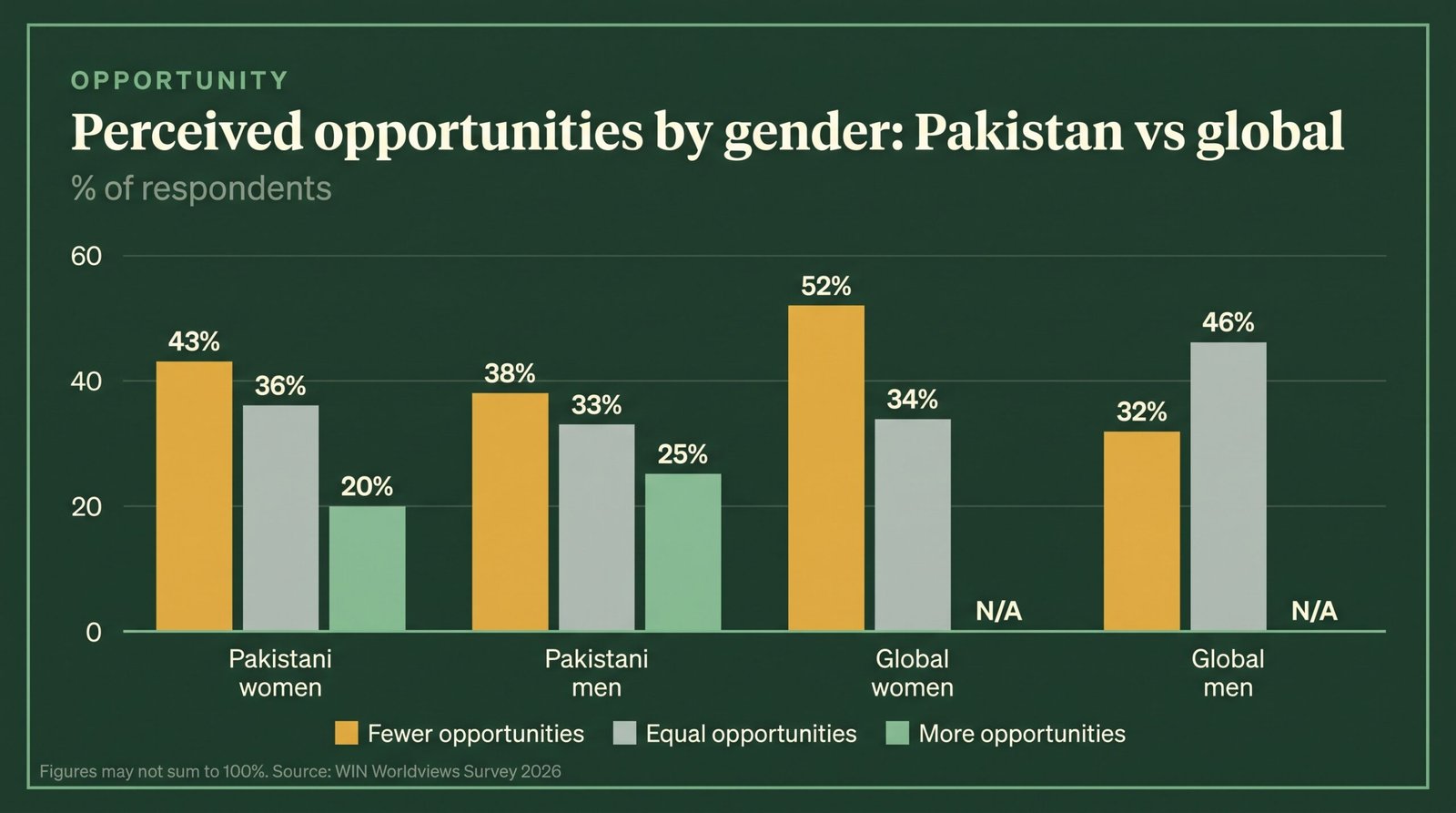
This internal variance represents a remarkably tight consensus when juxtaposed against the global baseline. Internationally, the gender perception gap violently widens to a 20-percentage-point chasm. Over half of all women globally, or 52%, report facing systemic disadvantages, contrasted sharply against only 32% of men who acknowledge the disparity.
Conversely, 46% of international men claim true market parity exists, a sentiment echoed by merely 34% of global women.
The “WIN Worldviews Survey 2026” also highlighted severe regional disparities across different geopolitical zones. At the apex of labor market optimism, the Philippines led the index with 74% of its population citing equal opportunities, trailed by Vietnam at 67% and Venezuela at 66%.
“Overall, the findings suggest that while perceptions of women’s career disadvantage remain significant in Pakistan, the degree of disagreement between men and women is less pronounced than in the global picture.”
On the opposite end of the spectrum, deeply entrenched pessimism dominated European and South American labor markets. Croatia recorded the highest perception of female disadvantage at 67%. This was closely followed by France, Italy, and Germany, all stagnating at 62%, while Brazil registered 59%.
Pakistan’s 40% metric securely positions the nation between these global extremes, navigating a complex middle ground where structural disadvantages are widely acknowledged, yet the internal ideological divide between male and female workers remains exceptionally muted compared to international benchmarks.