

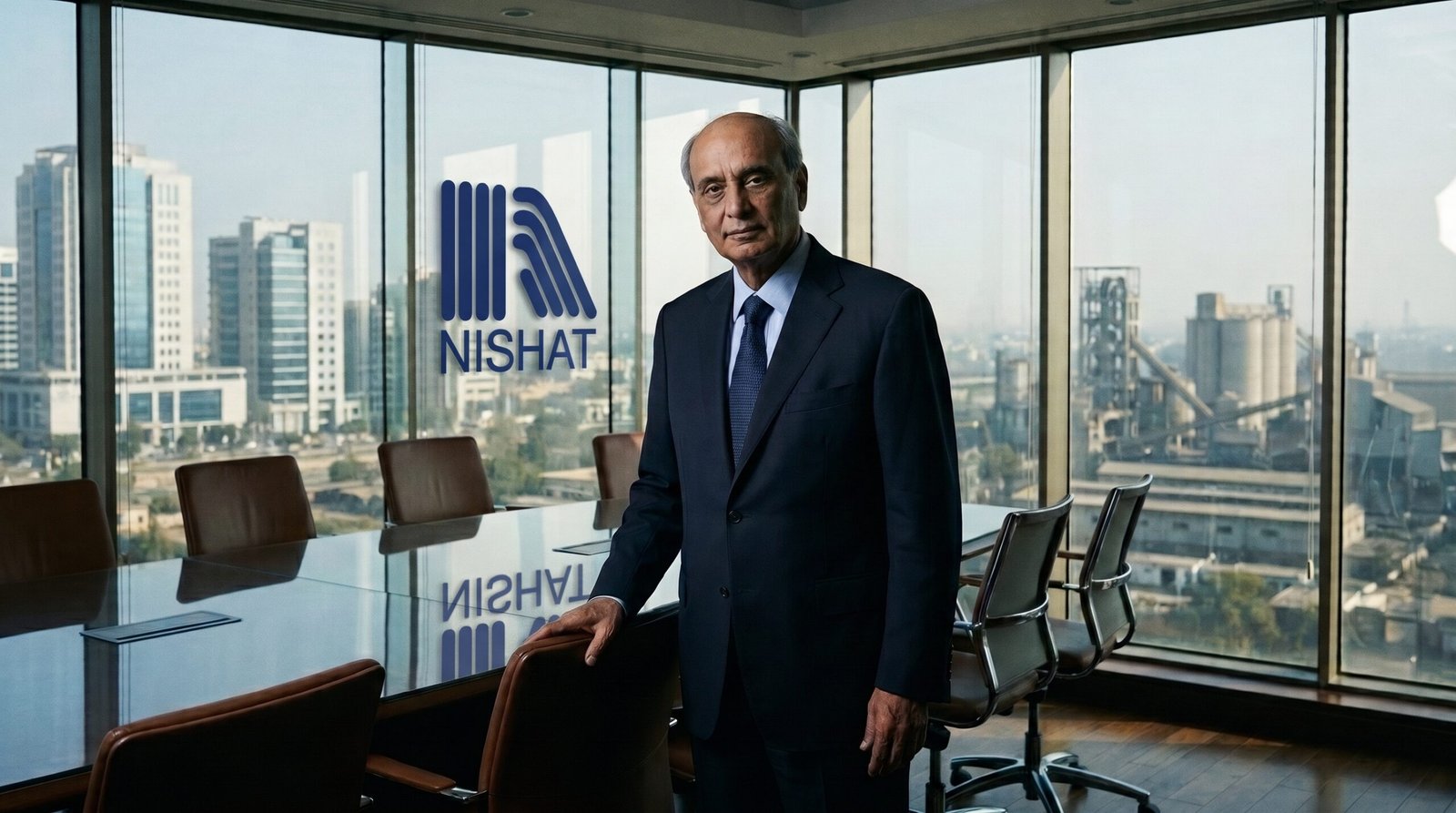
LAHORE: Mian Muhammad Mansha is widely recognised as one of Pakistan’s most influential businessmen. But the financial story behind the Nishat Group is considerably more complex than the familiar narrative of a textile magnate who built a multibillion-dollar business empire.
An examination of publicly reported corporate financial statements reveals a network of businesses spanning banking, textiles, cement, insurance, electricity generation, automobile manufacturing, hospitality, agriculture and industrial food processing.
Across these sectors, companies associated with the wider Nishat business network generate billions of rupees in annual profits, manage substantial assets and carry significant financial obligations.
Yet the numbers tell contrasting stories.
Nishat Mills, the historic flagship of the group, reported declining standalone profitability despite higher sales during the financial year ended June 2026. MCB Bank, meanwhile, earned more than Rs54 billion in 2025, while D.G. Khan Cement reported annual profits exceeding Rs11 billion.
Adamjee Insurance also delivered strong earnings, demonstrating how Nishat-associated investments extend well beyond the group’s traditional manufacturing activities.
But behind these impressive figures lies an important distinction: the assets, profits and liabilities of these companies cannot automatically be attributed to Mansha personally.
Nishat Group is not one publicly listed corporation with a single consolidated balance sheet covering every business associated with the family. Instead, it comprises a complex network of listed companies, privately held businesses, joint ventures, subsidiaries and associated investments.
The real story is therefore not simply how much money Mansha’s businesses generate, but how their financial performance, ownership arrangements and investment decisions shape the wider corporate empire.
From Textile Mills To One Of Pakistan’s Biggest Business Networks
The Nishat Group traces its origins to the textile industry, which formed the foundation of its early commercial success.
Under Mian Mansha’s leadership, the business expanded into sectors that were fundamentally different from its original manufacturing operations.
Banking became one of the most significant areas of expansion, while cement production provided exposure to construction and infrastructure development.
Insurance added another financial services business, and investments in electricity generation positioned the group within Pakistan’s energy sector.
Later expansion into automobile manufacturing, hospitality, agriculture and other industries broadened its commercial footprint.
This diversification helped create a business network exposed to multiple sources of revenue and economic activity.
However, diversification also introduced new risks.
Textile companies face international competition, export-market volatility and high production costs. Banks operate within a tightly regulated financial system. Cement manufacturers depend heavily on construction demand and energy prices, while automobile companies remain exposed to import restrictions, exchange-rate movements and consumer purchasing power.
The fortunes of these businesses therefore do not necessarily move together.
That distinction becomes clear when their financial statements are examined.
Nishat Mills: Rs181 Billion In Sales, But Profits Under Pressure
Nishat Mills Limited remains one of the most important companies associated with Mansha’s industrial empire.
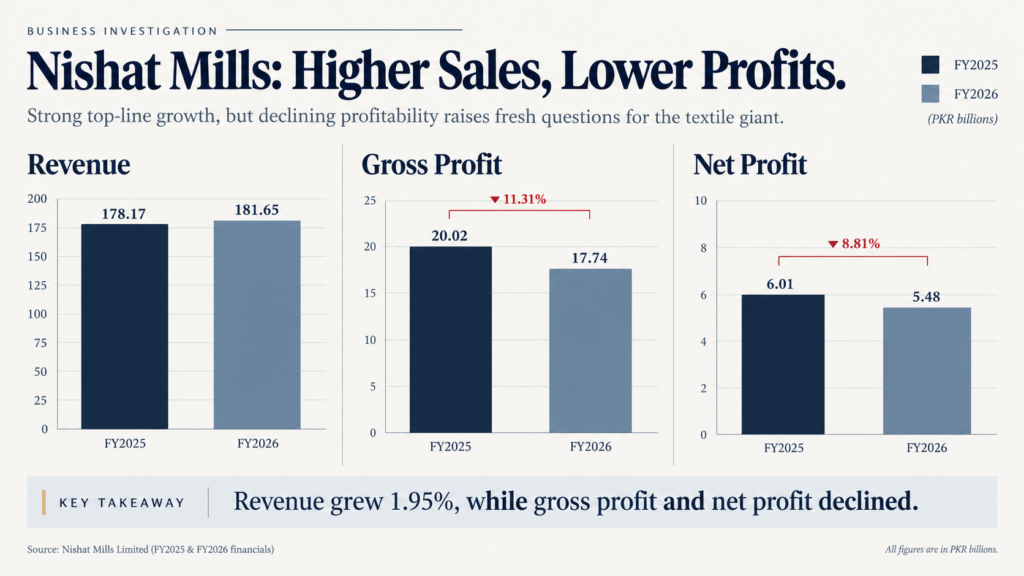
For the financial year ended June 30, 2026, the company reported standalone revenue of approximately Rs181.65 billion, compared with Rs178.17 billion during the preceding year.
The increase represented revenue growth of approximately 1.95 per cent.
However, the company’s profitability weakened.
Gross profit declined from approximately Rs20.02 billion to Rs17.74 billion, while net profit fell from Rs6.01 billion to Rs5.48 billion.
The figures suggest that increasing sales did not translate into improved manufacturing earnings.
Nishat Mills: Financial Performance
|
Indicator |
FY2025 | FY2026 |
|
Revenue |
Rs178.17bn |
Rs181.65bn |
|
Gross profit |
Rs20.02bn |
Rs17.74bn |
|
Finance costs |
Rs8.43bn |
Rs6.38bn |
|
Net profit |
Rs6.01bn |
Rs5.48bn |
|
Gross profit margin |
11.24% |
9.76% |
| Net profit margin | 3.38% |
3.02% |
The decline in gross profit margin is particularly significant.
It indicates that the company retained a smaller proportion of its revenue after accounting for the direct costs of production.
For a major textile manufacturer, profitability depends on several factors, including raw material prices, electricity and gas tariffs, labour costs, export demand and financing conditions.
Nishat Mills’ performance demonstrates the challenges confronting Pakistan’s large industrial exporters.
Despite its established market position and diversified operations, the company faced pressure on margins.
Billions In Debt: What Nishat Mills’ Borrowings Reveal
The financial position of Nishat Mills also provides an important perspective on corporate borrowing.
At June 30, 2026, the company reported standalone assets of approximately Rs277.69 billion.
Its short-term borrowings stood at approximately Rs60.54 billion.
The company also carried long-term financing obligations, while annual finance costs amounted to approximately Rs6.38 billion.
Although finance costs declined from Rs8.43 billion in the preceding year, they remained substantial relative to standalone net profit.
The relationship between borrowing costs and earnings is particularly important for manufacturing businesses.
Companies frequently use bank financing to purchase raw materials, fund inventories, support exports and manage working capital.
Consequently, large borrowings do not automatically indicate financial weakness.
However, they expose businesses to changes in interest rates, credit availability and cash-flow conditions.
A meaningful assessment of Nishat Mills’ debt position must consider the company’s operating cash flows, borrowing maturities, liquidity, financing arrangements and capacity to meet financial obligations.
The distinction is essential because corporate debt belongs to the relevant company and cannot automatically be treated as a personal liability of Mansha.
Consolidated Profits Surge Despite Textile Weakness
While Nishat Mills’ standalone results showed declining profitability, its consolidated financial performance was considerably stronger.
Consolidated revenue increased from approximately Rs207.18 billion in FY2025 to Rs213.63 billion in FY2026.
Consolidated profit after taxation increased from approximately Rs4.74 billion to Rs15.62 billion.
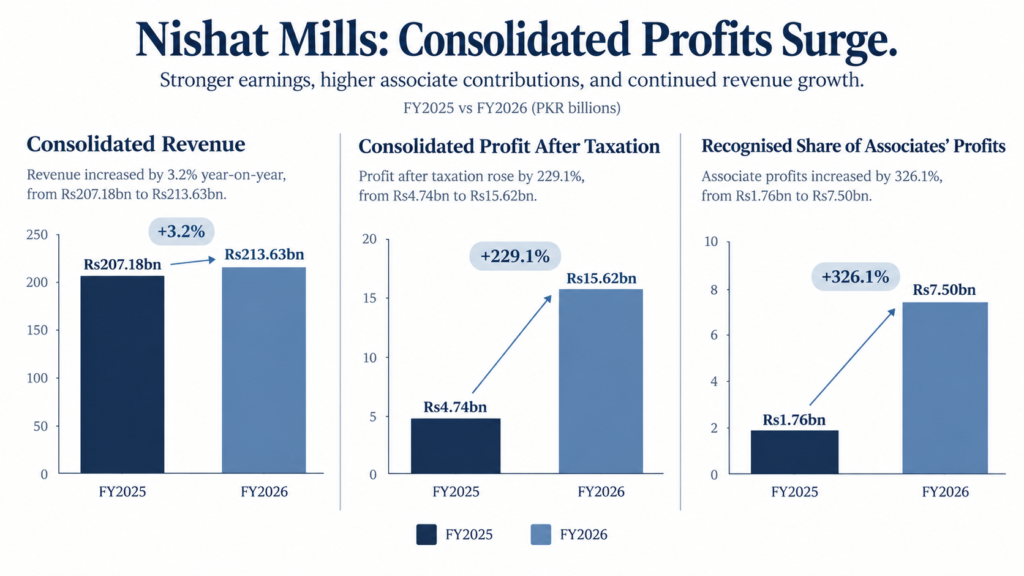
That represents an increase of nearly 230 per cent.
The difference between standalone and consolidated profitability reflects the financial contribution of subsidiaries, associates and other investments recognised under the applicable accounting rules.
The company’s recognised share of associates’ profits reportedly increased from approximately Rs1.76 billion to Rs7.50 billion.
This illustrates one of the defining features of Nishat’s corporate structure.
The financial performance of the wider investment portfolio can significantly influence consolidated earnings even when the core textile manufacturing business experiences weaker margins.
For investors, the distinction matters because strong consolidated profits do not necessarily indicate an equivalent improvement in manufacturing profitability or operating cash generation.
MCB Bank: The Financial Powerhouse
MCB Bank represents one of the most financially significant companies associated with the wider Nishat business network.
The bank operates across corporate banking, retail banking, trade finance, deposits and investment activities.
For calendar year 2025, MCB reported total income of approximately Rs181.40 billion and profit after taxation of approximately Rs54.20 billion.
Its total assets reached approximately Rs3.25 trillion.
The bank’s profit was substantially higher than the standalone earnings reported by Nishat Mills and D.G. Khan Cement.
However, comparing banks with industrial companies requires caution.
A bank’s balance sheet includes deposits, investments, financing assets and liabilities governed by financial-sector accounting and prudential regulations.
Its total assets cannot be interpreted as shareholder wealth.
Similarly, MCB’s entire annual profit does not belong to Mansha personally.
The economic benefit attributable to any individual investor depends on direct and indirect shareholdings, dividend distributions and changes in the value of those holdings.
Nevertheless, MCB’s scale demonstrates the importance of banking within the broader Nishat-associated business network.
The bank also illustrates how financial services can generate substantially different returns from industrial manufacturing.
D.G. Khan Cement: From Losses To Rs11 Billion Profit
D.G. Khan Cement Company Limited is another major industrial business associated with the Nishat network.
The company reported standalone revenue of approximately Rs79.56 billion for FY2026, compared with Rs71.89 billion in FY2025.
Its net profit increased from approximately Rs8.68 billion to Rs11.43 billion.
The increase represented profit growth of approximately 31.7 per cent.
The improvement followed a period of weaker financial performance.
In FY2023, D.G. Khan Cement reported a loss of approximately Rs3.64 billion.
By FY2024, it had returned to a modest profit of approximately Rs542 million, followed by stronger earnings in subsequent years.
The turnaround demonstrates how industrial profitability can change significantly with financing conditions, operating costs, pricing and investment returns.
However, a complete assessment must distinguish profits generated by cement operations from other income, investment gains and tax effects.
The company has also participated in a significant diversification initiative involving Rafhan Maize Products.
Rafhan Maize: A Strategic Move Beyond Cement And Textiles
The acquisition of an interest in Rafhan Maize Products represents an important development in Nishat’s diversification strategy.
Rafhan is an established producer of maize-based industrial ingredients used in food processing, pharmaceuticals, textiles and other manufacturing industries.
The reported investment by D.G. Khan Cement involved an approximately 31.07 per cent shareholding and a transaction value of around Rs28.4 billion.
The wider transaction involved other Nishat-associated investors.
The strategic significance extends beyond the acquisition of another manufacturing business.
Rafhan operates in a sector with different demand characteristics from cement and textile production.
Its products are used by multiple industries, potentially providing exposure to more diverse customers and commercial applications.
However, the financial success of the acquisition will depend on the price paid, financing arrangements, future earnings, dividend distributions and the ability of the business to generate sustainable cash flows.
The investment also raises a capital allocation question.
Should a cement manufacturer deploy substantial capital into an unrelated industrial business, or would shareholders benefit more from reinvestment in existing operations, debt reduction or dividend distributions?
The answer depends on the expected financial returns and strategic benefits of the acquisition.
Adamjee Insurance: Another Profitable Pillar
Adamjee Insurance Company Limited adds another important dimension to the wider business network.
For calendar year 2025, the company reported gross premiums written of approximately Rs63.14 billion.
Profit after taxation reached approximately Rs5.13 billion.
The performance demonstrates the scale of the insurance business associated with the group.
However, insurance companies cannot be assessed using precisely the same financial measures as manufacturing businesses.
Their profitability depends on underwriting results, claims experience, investment income and the management of insurance liabilities.
Gross premiums written are not directly equivalent to industrial sales revenue.
Nevertheless, Adamjee’s earnings demonstrate how Nishat-associated investments extend across different parts of Pakistan’s financial services industry.
Power Generation: Nishat Power, Pakgen And Lalpir
Power generation has historically formed another important part of the group’s investment portfolio.
Companies associated with the network include Nishat Power, Pakgen Power and Lalpir Power.
These businesses have operated within Pakistan’s independent power producer framework.
The financial performance of power producers depends on contractual arrangements, generation activity, capacity payments, fuel costs, receivables and settlements with electricity purchasers.
Pakistan’s energy sector has undergone significant policy changes, including negotiations over power purchase agreements and efforts to reduce the financial burden of electricity generation.
Such developments can materially affect future earnings.
An important corporate restructuring disclosed in Nishat Mills’ FY2026 reporting concerned Pakgen.
Nishat Mills’ ownership interest reportedly increased from 30.25 per cent to 58.57 per cent following a share buyback and cancellation.
The resulting increase in ownership illustrates how control of a company can change without the purchase of additional shares by an existing shareholder.
It also demonstrates why understanding Nishat’s corporate network requires more than identifying the names of associated businesses.
Share buybacks, capital restructuring and changes in ownership percentages can alter financial reporting and control relationships.
Hyundai Nishat: The Automobile Gamble
Nishat’s entry into automobile manufacturing represented another major diversification initiative.
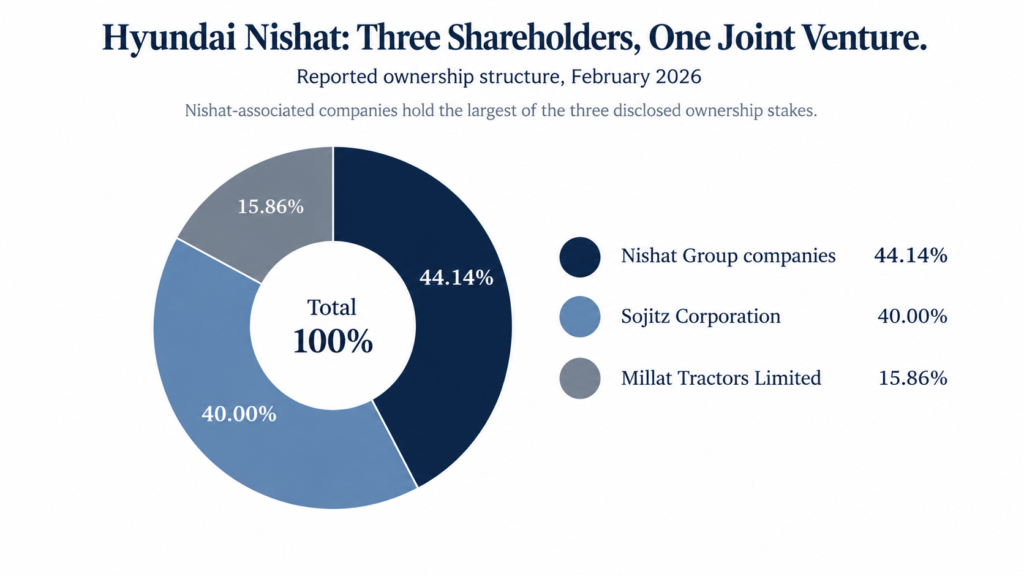
Hyundai Nishat Motor operates through a joint venture involving Nishat-associated companies, Japan’s Sojitz Corporation and Millat Tractors Limited.
A February 2026 credit rating report identified the ownership structure as 44.14 per cent for Nishat Group companies, 40 per cent for Sojitz Corporation and 15.86 per cent for Millat Tractors.
The venture has established a manufacturing and distribution presence in Pakistan’s automobile market.
However, automobile manufacturing requires substantial capital investment and remains exposed to economic uncertainty.
Exchange-rate fluctuations, import regulations, financing costs, component availability and consumer demand can all affect performance.
Unlike listed companies, Hyundai Nishat does not publish the same range of financial information through routine Pakistan Stock Exchange disclosures.
Its precise contribution to the wider Nishat network’s profits and debt therefore cannot be established from the listed-company figures alone.
Hospitality, Real Estate And Agriculture: The Less Visible Businesses
Beyond the publicly listed companies, Nishat-associated businesses have interests in hospitality, property development, agriculture and dairy operations.
These investments broaden the network’s commercial exposure beyond financial services and industrial manufacturing.
However, private businesses generally disclose less financial information publicly than companies listed on the Pakistan Stock Exchange.
As a result, their revenues, assets, liabilities and profits cannot be incorporated into a reliable group-wide total without appropriate financial statements.
This limitation is particularly important when attempting to calculate the overall size of Mansha’s business empire.
The absence of publicly available financial figures does not mean that these businesses are financially insignificant.
It means their contribution cannot be measured with the same degree of transparency as listed companies.
The Numbers Behind The Empire
The financial disclosures of four major companies illustrate the scale and diversity of the Nishat-associated business network.
| Company | Reporting period | Revenue or income | Net profit |
| Nishat Mills (standalone) | FY2026 | Rs181.65bn | Rs5.48bn |
| D.G. Khan Cement (standalone) | FY2026 | Rs79.56bn | Rs11.43bn |
| MCB Bank | CY2025 | Rs181.40bn total income | Rs54.20bn |
| Adamjee Insurance | CY2025 | Rs63.14bn gross premiums written | Rs5.13bn |
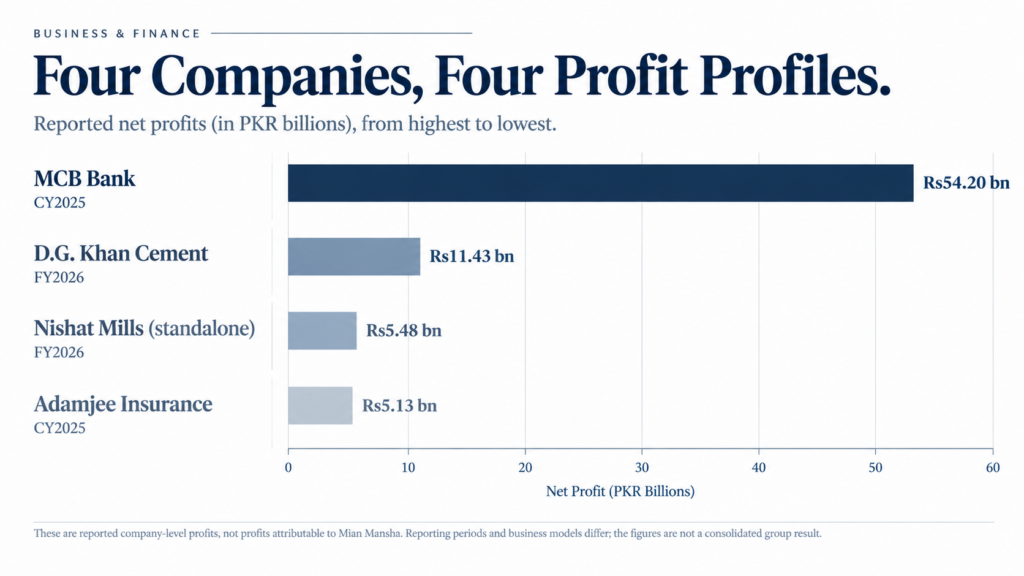
The figures demonstrate that the associated companies operate at substantial financial scale.
However, adding their reported income or profits together would not produce a reliable consolidated figure for Nishat Group.
The companies have different reporting periods, accounting treatments, ownership arrangements and business models.
Their financial statements may also reflect overlapping investments and transactions.
A group-wide financial calculation would require a complete ownership map and adjustments to eliminate double counting.
Also Read: Ghani Chemical Industries Pioneers Tracking Shares To Fund Rs 6 Billion Natural Gas Ventures
How Rich Is Mian Mansha?
Mian Mansha has frequently featured in discussions about Pakistan’s wealthiest businessmen.
However, calculating his personal net worth requires considerably more than adding the assets of companies associated with the Nishat name.
A reliable valuation would require identifying his direct shareholdings, indirect ownership interests and economic rights across listed and privately held companies.
Publicly traded holdings could be valued using share prices on a specified date.
Private businesses would require separate valuations based on their earnings, assets, cash flows or comparable transactions.
Relevant liabilities would also need to be considered.
Crucially, interests held by other family members, joint-venture partners, institutional investors and public shareholders cannot automatically be attributed to Mansha.
A bank’s total assets, a manufacturer’s annual sales and an insurance company’s gross premiums are not measures of personal wealth.
Without a complete ownership and valuation exercise, assigning an exact current net worth would be speculative.
A Web Of Companies: The Ownership And Governance Question
One of the defining features of Nishat’s business network is the presence of multiple companies with overlapping investment relationships.
Some businesses hold shares in other associated companies.
Others operate through joint ventures with international or domestic partners.
These arrangements can support diversification, financing and strategic investment.
However, they also make it more difficult for outside observers to determine the precise economic exposure of individual shareholders.
Related-party transactions, intercompany investments and changes in corporate control therefore deserve close examination.
Such arrangements are not inherently improper and are common among diversified corporate groups.
Their significance lies in whether they are appropriately disclosed, commercially justified and conducted in accordance with applicable regulations.
For minority shareholders, the important questions concern transparency, capital allocation, corporate governance and the protection of shareholder interests.
The long-term sustainability of a diversified business network depends not only on profitability but also on the quality of its financial reporting and management decisions.
The Next Generation: Who Will Run The Empire?
The future of Nishat also involves the question of generational leadership.
As business groups expand across industries, responsibilities are increasingly distributed among professional executives and members of the controlling business families.
This creates opportunities for continuity, but it also introduces questions about succession planning, corporate governance and strategic priorities.
The automobile joint venture, for example, has involved senior leadership roles for members of the Mansha family.
The broader challenge is ensuring that individual companies retain effective management structures while benefiting from the strategic resources of the wider network.
For shareholders, succession planning matters because changes in leadership can influence investment decisions, risk appetite and long-term corporate strategy.
What Nishat’s Financial Performance Reveals About Pakistan’s Economy
The financial results of Nishat-associated companies offer a broader perspective on Pakistan’s economic structure.
Manufacturing businesses remain exposed to high production costs, energy prices, financing requirements and international competition.
Banks operate under a different model, with profitability influenced by interest rates, deposits, financing activity and investments.
Cement producers depend on construction demand, industrial activity and input costs.
Insurance companies generate earnings through underwriting and investment operations.
These differences help explain why the financial performance of companies within the same wider business network can vary substantially.
The contrast between Nishat Mills’ weakening manufacturing margins and the profitability of financial services businesses raises an important economic question.
Can Pakistan create an environment in which industrial production and exports generate returns sufficiently attractive to encourage sustained investment?
For a country seeking higher exports, industrial development and employment growth, the answer matters far beyond one business group.
The Empire’s Biggest Challenge May Not Be Its Size
The financial statements reveal that the Nishat-associated business network has achieved considerable diversification.
Its investments span sectors that are central to Pakistan’s economy.
But scale does not eliminate risk.
Large industrial businesses remain vulnerable to weak demand, expensive energy, financing costs and regulatory uncertainty.
Financial services businesses face their own risks, including changes in monetary policy, credit quality and investment markets.
Power generation is exposed to contractual and policy developments, while automobile manufacturing depends heavily on economic stability and consumer confidence.
The challenge for a diversified business group is therefore not simply to expand into additional industries.
It is to allocate capital effectively, manage debt responsibly, protect shareholder value and generate sustainable returns across different economic cycles.
The Real Story Behind Mian Mansha’s Billions
Mian Mansha’s business empire represents one of the most prominent examples of private-sector diversification in Pakistan.
The available financial disclosures show that companies associated with the Nishat network generate substantial profits, control major operating assets and maintain significant borrowing arrangements.
They also demonstrate that financial performance varies sharply across the network.
Nishat Mills experienced declining standalone profitability despite higher sales, while its consolidated results benefited from the contribution of associated investments.
MCB Bank remained a major profit-generating financial institution, D.G. Khan Cement reported stronger earnings, and Adamjee Insurance continued to contribute to the wider financial services portfolio.
Meanwhile, investments in food processing, automobiles, power generation and private ventures have expanded the network’s commercial reach.
Yet the true value of Mansha’s personal holdings remains distinct from the aggregate financial scale of these businesses.
The empire that Mian Mansha built is therefore more than a story of billions in revenue, profits and debt. It is a story of how industrial wealth evolved into a diversified corporate network — and how its future will depend on profitability, financial discipline, governance and the direction of Pakistan’s economy.