

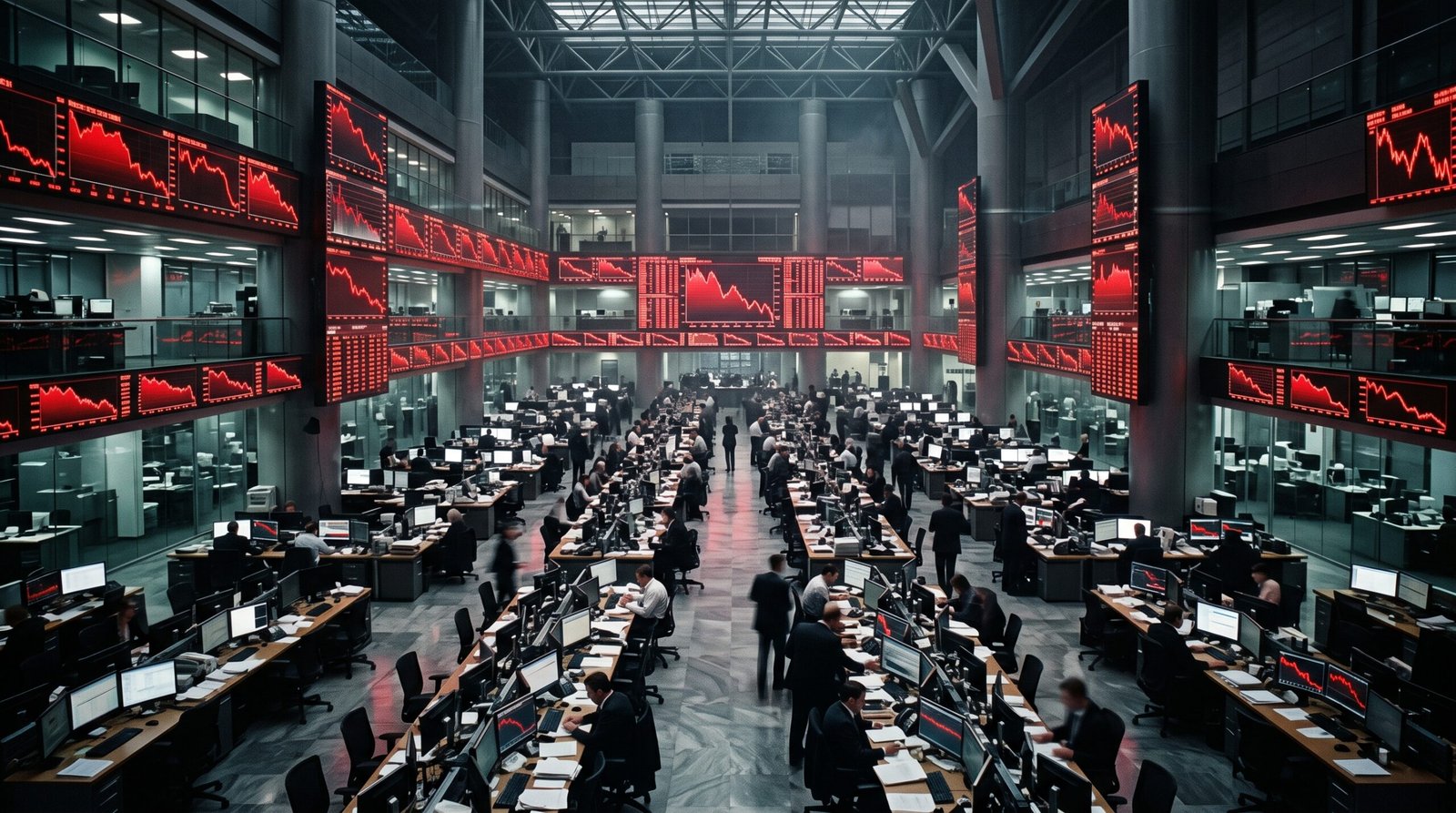
The Pakistan Stock Exchange (PSX) experienced an immediate sell-off during early Monday trading, mirroring a broader contraction across Asian markets as global investors weighed escalating tech-sector funding concerns against shifting geopolitical oil dynamics.
At 9:45 a.m., the benchmark KSE-100 Index fell to 166,059.72, shedding 359.99 points or 0.22% in the opening minutes. The aggressive selling pressure was broadly distributed across critical industrial and financial segments, strictly impacting automobile assemblers, cement manufacturers, commercial banks, oil and gas exploration companies, and oil marketing companies (OMCs).
Also Read: Pakistan’s Twenty Largest Listed Textile Companies Generate $5 Billion In Sales As Profits Rise 11%
Market depth indicators showed severe weakness among index-heavyweight equities. Corporate giants including HUBCO, MARI, PPL, PSO, SSGC, SNGPL, HBL, NBP, and UBL all traded in the red, effectively suppressing any upward domestic momentum. The domestic decline follows a highly cautious Friday session, where the index had managed a marginal gain of 233.55 points, or 0.14%, closing at 166,419.72 due to an absence of localized market triggers and elevated international crude prices.
“Unease over AI’s enormous funding needs undermined confidence ahead of a week packed with earnings, while Chinese economic data pipped forecasts in a positive for world growth.”
The localized equities drop aligns with a significant pullback across the Asia-Pacific region. Regional equities suffered as structural anxieties regarding the immense capital requirements of artificial intelligence infrastructure forced a retreat from tech-heavy indices.
| Regional Equity Index | Daily Decline | Previous Week Performance |
| Japan Nikkei | -1.2% | -5.4% |
| Taiwan TAIEX | -1.4% | N/A |
| MSCI Asia-Pacific (ex-Japan) | -0.6% | N/A |
| South Korea (KOSPI) | -0.4% | -14.0%+ |
Global energy and bond markets injected further volatility into the trading session. International oil prices retreated following an initial decision by United States President Donald Trump to waive specific sanctions on Russia. While the administration subsequently clarified that a definitive resolution remains pending, the announcement immediately triggered downward pressure on crude futures.
Addressing the potential policy shift, U.S. Secretary of State Marco Rubio stated on Saturday that the president will take up to 60 days to formally evaluate the macroeconomic consequences of the waiver. This geopolitical maneuver overshadowed simultaneous maritime escalations in the Middle East, where Iranian authorities reported that a commercial tanker had hit a naval mine within the Strait of Hormuz.
The convergence of Middle Eastern naval hostilities and tech-sector capitalization fears accelerated a flight to “safe-haven” assets. Institutional capital rotated aggressively from equities into sovereign debt, extending a sustained rally in global bond markets. Consequently, the benchmark 10-year U.S. Treasury yield contracted by 4 basis points to 5.0525%, capping its most severe weekly decline in over eight months.
Despite the severe drag on Asian equities, U.S. market projections indicated an impending rebound. Capitalizing on the lower bond yields, Wall Street futures absorbed the displaced capital flows, driving S&P 500 futures up 0.7% and Nasdaq futures higher by 1.0% ahead of the New York opening bell.