

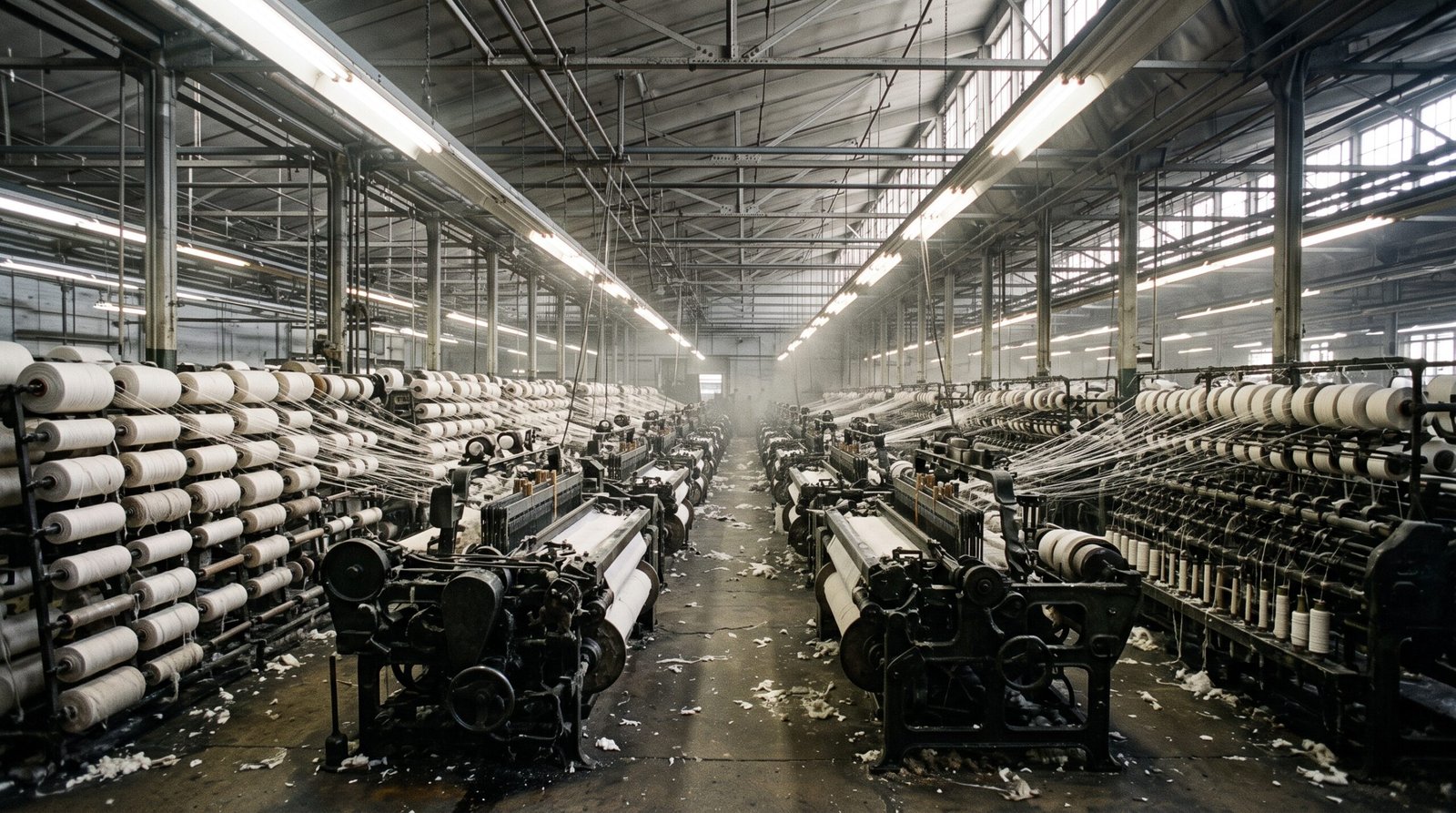
Pakistan’s largest publicly traded textile manufacturers have managed to extract an 11.4% increase in collective profitability despite an outright stagnation in revenue, signaling that recent financial relief mechanisms are currently sustaining the nation’s premier export industry rather than actual manufacturing growth.
The country’s 20 leading listed textile companies generated a combined revenue of Rs1.40 trillion, or approximately $5 billion, during the financial year ending June 30, 2026. While this represents a marginal top-line contraction of 0.3% from the preceding year, cumulative net income surged from Rs46.7 billion to Rs52.0 billion.
The findings were detailed in a comprehensive sectoral assessment published by Rabia Yousuf, an equities analyst at Topline Securities. The analyzed cohort, which operates across composite textile, spinning, weaving, woollen, and apparel segments, accounts for 83% of the sector’s total market capitalization on the local exchange.
“The improvement, however, owes more to declining financing costs and changes in taxation than to a broad recovery in manufacturing profitability.”
Financial statements reveal that gross profitability across the sector remained structurally constrained. The combined gross profit edged down 0.2% to Rs183.71 billion, locking gross margins broadly stable at 13.1%. The sector has continuously struggled with exorbitant domestic energy tariffs and intensified international competition.
However, external financial pressures eased considerably. Corporate finance costs declined 19.2% year-on-year, dropping from Rs67.43 billion to Rs54.51 billion in FY2026. Topline Securities attributed this substantial reduction to normalized financing rates and a strategic decrease in corporate borrowings under the government’s “Export Finance Scheme”.
Simultaneously, the effective tax rate levied on these companies fell from 37.1% to 33.2%. This drop was driven largely by the reversal of deferred tax liabilities following legislative changes to the future “super tax” treatment applied to exporters. Consequently, combined profit before tax ticked up 3.4% to Rs78.80 billion, while actual tax expenses contracted by 7.6% to Rs26.14 billion.
The overall sectoral gains were aggressively consolidated at the top. Just three corporate entities—Interloop Limited, Sapphire Textile Mills, and Nishat Mills Limited—accounted for 48% of the entire sector’s combined earnings.
| Textile Manufacturer | FY2026 Net Profit | FY2026 Sales Revenue | Year-Over-Year Profit Variance |
| Interloop Limited (Consolidated) | Rs12.70 billion | Rs187.70 billion | +129% |
| Sapphire Textile Mills (Unconsolidated) | Rs6.82 billion | Rs81.18 billion | +73% |
| Nishat Mills Limited (Unconsolidated) | Rs5.48 billion | Rs181.65 billion | -9% |
Interloop Limited anchored the sector by posting a massive 129% profit expansion, heavily supported by discounted income from external investments and a 35% reduction in internal finance costs. Conversely, Sapphire Textile Mills achieved a 73% profit surge despite a 13% contraction in direct sales, driven almost entirely by lower borrowing costs, reduced effective tax rates, and a doubling of non-operational income. Nishat Mills Limited recorded a 9% profit decline, hindered primarily by contracting gross margins.
While raw material input prices remained stable—with local cotton averaging Rs18,353 per maund and the international Cotlook A Index holding around $0.79 per pound—the flat sales recorded by the top 20 firms present a glaring divergence from national macroeconomic data.
According to external figures cited in the report, Pakistan’s broader textile exports reached a record $17.6 billion in FY2026, marking a 2% national increase. Value-added textile shipments alone rose 3% to $13 billion. The discrepancy between the record national export volume and the stagnant revenue of the largest publicly traded firms indicates that the recent export growth has bypassed the traditional corporate giants, migrating instead toward unlisted entities or alternative manufacturing tiers.
1 comment