

Pakistan’s microfinance industry is approaching a critical phase of transformation as financial institutions, fintech companies, regulators and digital payment providers increasingly recognise that collaboration, rather than competition, could determine the next stage of financial inclusion in the country.
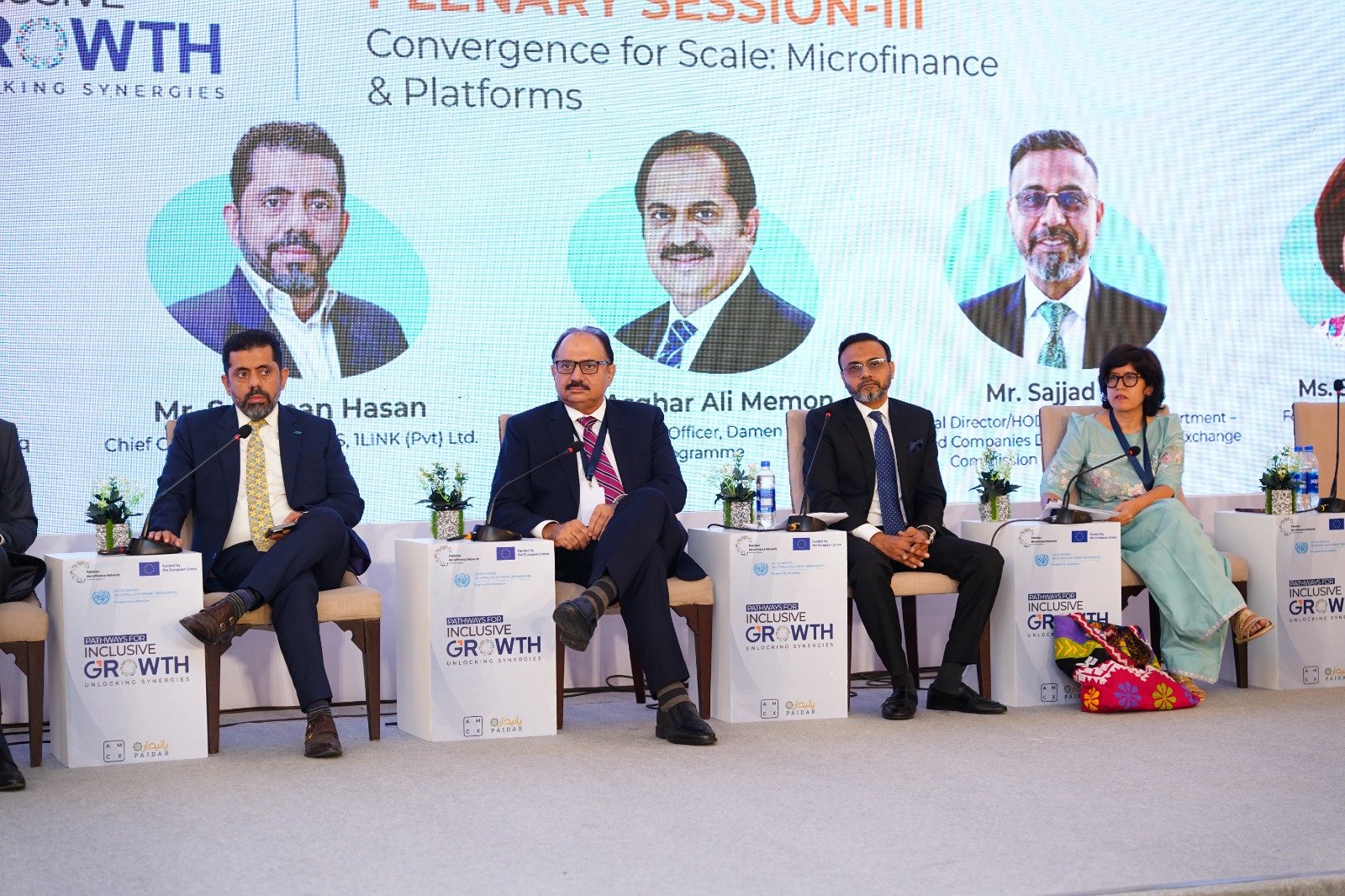
The emerging shift towards integrated financial services dominated discussions at the 10th Annual Microfinance Conference (AMC-X), held at Mövenpick Hotel, Karachi, on October 7–8, 2026, under the theme “Pathways for Inclusive Growth: Unlocking Synergies”.
Industry leaders warned that Pakistan’s expanding digital payment infrastructure would deliver limited economic benefits unless accompanied by financial literacy, consumer protection, responsible lending and greater access to financial services for underserved communities.
The discussions reflected a growing recognition that Pakistan’s financial inclusion challenge is no longer limited to building digital infrastructure. The more pressing question is how existing technological capabilities can be translated into meaningful financial opportunities for millions of people who remain outside, or are inadequately served by, the formal financial system.
Microfinance Industry At A Critical Crossroads
Pakistan’s microfinance industry has established an extensive network of financial institutions serving millions of borrowers, particularly low-income households, small entrepreneurs and women who traditionally face difficulties accessing commercial banking services.
However, the rapid emergence of digital wallets, fintech lenders, instant payment systems and digital banking platforms is fundamentally changing the financial services landscape.
Traditional microfinance institutions have historically relied on physical branches, field officers and direct relationships with borrowers to assess creditworthiness, disburse loans and collect repayments.
Digital financial service providers, meanwhile, are introducing electronic customer verification, automated credit assessment, instant payments and digital loan disbursement systems.
The challenge facing the industry is determining how these two models can operate together without compromising the customer relationships and local knowledge that have traditionally supported responsible microfinance lending.
At the conference, participants argued that the future of financial inclusion lies in combining the strengths of established institutions with the efficiency and scalability of modern financial technology.
Industry Leaders Debate Digital Convergence
A plenary session titled “Convergence for Scale: Microfinance Meets Digital Banks, Fintechs & Platforms” brought together senior representatives from Pakistan’s regulatory, financial technology, payment infrastructure and microfinance sectors.
The session was chaired by Muhammad Saad Akhtar, Head of Raast Operations at Raast Payments Pakistan (Pvt.) Ltd.
Participants included Humza Hussain, Chief Product and Strategy Officer at Tasdeeq; Arslan Khan, Country Manager at Mastercard; Suleman Hasan, representing 1LINK; Asghar Ali Memon, Chief Executive Officer of DAMEN Support Programme; Sajjad Ali, Additional Director and Head of the Lending and PF Department in the Securities and Exchange Commission of Pakistan’s Specialized Companies Division; and Sadaffe Abid, Chief Executive Officer of Circle Women.
The discussion examined whether digital banks and fintech companies should build independent financial infrastructure or collaborate with existing microfinance institutions to expand their outreach.
A central argument emerging from the session was that Pakistan already possesses complementary strengths across its financial ecosystem.
While traditional institutions maintain relationships with underserved communities, digital platforms offer technological capabilities that can improve speed, transparency and operational efficiency.
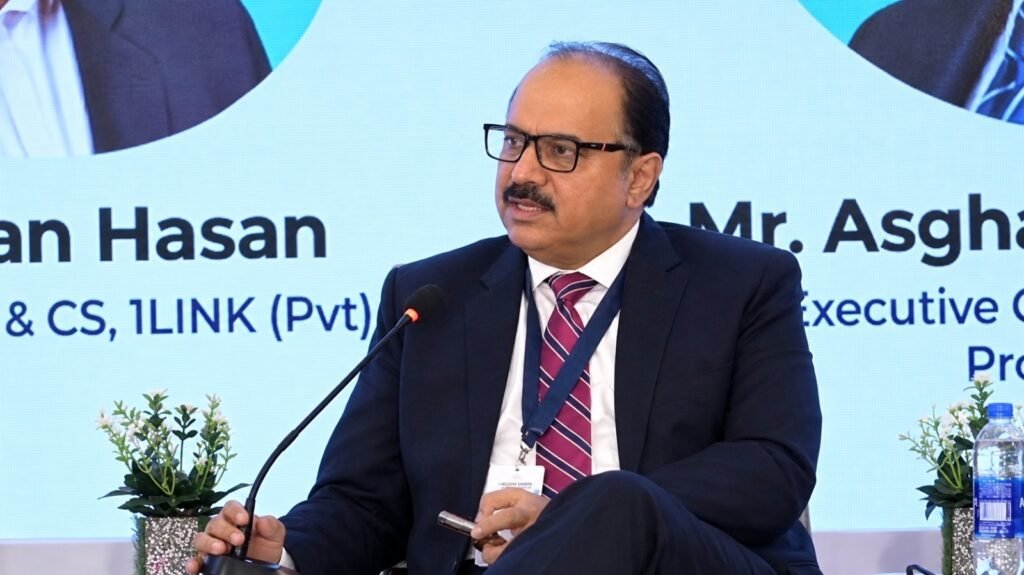
DAMEN CEO Advocates ‘Phygital’ Financial Model
Asghar Ali Memon, Chief Executive Officer of DAMEN Support Programme, argued that Pakistan’s future financial inclusion strategy should combine physical customer engagement with digital financial services.
Describing the approach as “Phygital”, Memon maintained that technology should complement rather than replace the strengths of established microfinance institutions.
He explained that microfinance providers have spent decades building trust within communities, developing relationships with borrowers and understanding local economic conditions.
Their field teams possess knowledge of household incomes, repayment capacity and community-level financial behaviour that cannot easily be replicated through automated digital systems.
Digital financial service providers, on the other hand, offer technological capabilities including electronic Know Your Customer verification, digital identity authentication, instant payment processing and electronic loan disbursement.
Integrating these strengths could improve efficiency, transparency and financial accessibility while preserving the personal relationships that remain essential to responsible lending.
The proposed model challenges the assumption that digital financial services must replace traditional institutions to achieve greater efficiency.
Instead, partnerships between established microfinance providers and technology companies could offer a more practical route towards reaching underserved borrowers.
Read More: Pakistan’s Debt Has More Than Doubled Since 2020. Why Is The Borrowing Cycle Still Hard To Break?
DAMEN Reports Near-Complete Transition To Digital Repayments
One of the most significant operational developments highlighted during the conference was DAMEN Support Programme’s transition towards digital repayment systems.
Memon disclosed that almost all repayments received by the organisation are now processed through digital channels.
The development represents a substantial shift for an institution serving borrowers who have traditionally relied heavily on cash transactions.
He also revealed that DAMEN is participating in a pilot initiative jointly supported by the State Bank of Pakistan, the Securities and Exchange Commission of Pakistan and the Pakistan Microfinance Network.
Under the initiative, women borrowers are being issued ATM cards to access their loans and conduct financial transactions digitally.
The cards are intended to facilitate more than cash withdrawals, enabling borrowers to use mobile applications for loan repayments, utility bill payments and other financial services.
The initiative could potentially reduce the need for physical visits to financial institutions, improve convenience and strengthen transaction transparency.
For microfinance institutions, digital repayments may also reduce administrative costs associated with cash collection and improve financial record-keeping.
However, the conference did not disclose the number of women participating in the pilot, the value of loans processed or the programme’s measurable impact on borrowers’ financial independence.
These indicators will be important in determining whether the initiative can be expanded across the wider microfinance industry.
Rural Women Remain Excluded From Digital Financial Services
Despite Pakistan’s expanding digital payment infrastructure, access to technology remains uneven across the country.
Drawing on DAMEN’s experience across 20 districts of Punjab, Memon highlighted the difficulties faced by women in rural communities.
He observed that many women still do not own smartphones and frequently depend on mobile devices belonging to their husbands or sons.
In some villages, only a handful of women possess smartphones, creating barriers to independent financial participation.
Even when devices are available, many women lack the confidence or technical skills required to use digital banking applications.
These challenges raise important questions about whether Pakistan’s digital financial transformation is reaching the communities that need financial services most.
Limited device ownership can restrict women’s ability to access accounts, monitor loan balances, conduct transactions and make independent financial decisions.
Memon stressed that financial literacy and digital education must accompany investments in technological infrastructure.
He argued that microfinance institutions remain particularly well positioned to provide this support because of their established relationships with local communities.
The issue also highlights a broader distinction between digital access and meaningful financial inclusion.
Opening an account or introducing a payment application does not necessarily improve a person’s economic circumstances unless the individual can independently use the service and benefit from it.

1LINK Urges Institutions To Utilise Existing Infrastructure
Suleman Hasan of 1LINK highlighted the progress Pakistan has made in developing digital payment infrastructure.
He argued that financial institutions should make greater use of existing payment networks, application programming interfaces and technological solutions rather than investing in unnecessary infrastructure duplication.
The approach could allow banks, fintech companies and microfinance providers to concentrate on developing better financial products and customer experiences.
For smaller financial institutions, access to shared payment infrastructure could potentially reduce technology costs and improve operational efficiency.
However, achieving these benefits will require greater interoperability between financial service providers.
Industry participants identified seamless connectivity between payment systems, customer verification mechanisms, loan disbursement platforms and repayment channels as an important requirement for the next phase of financial integration.
Such interoperability could enable microfinance institutions to provide more efficient services without independently developing complex technological infrastructure.
Fintechs See Transaction Data As A New Credit Assessment Tool
Humza Hussain, Chief Product and Strategy Officer at Tasdeeq, emphasised the potential of transaction data, open banking and consent-based information sharing to improve credit assessment.
Traditional lending models frequently depend on formal income documentation, collateral and established banking histories.
These requirements can disadvantage small traders, informal workers and microentrepreneurs whose financial activity may not be fully captured through conventional banking records.
Digital transaction histories could provide additional information about income flows, repayment behaviour and financial activity.
With appropriate safeguards, such information may help lenders assess borrowers who might otherwise struggle to qualify for formal credit.
However, increased reliance on digital data also raises concerns about privacy, consent, accuracy and the potential misuse of personal information.
The challenge for fintech companies and regulators is to ensure that alternative credit assessment methods expand access without exposing borrowers to excessive debt or unfair lending practices.
SECP Emphasises Responsible Lending And Consumer Protection
Sajjad Ali, representing the Securities and Exchange Commission of Pakistan, stressed the need to balance financial innovation with responsible lending and consumer safeguards.
His intervention focused on transparency, borrower protection, data privacy and the importance of maintaining regulatory oversight as digital financial services expand.
The regulatory perspective is particularly relevant as technology-driven lenders increasingly adopt automated customer onboarding, credit scoring and loan disbursement systems.
While these technologies can accelerate access to finance, they can also create risks if borrowers do not fully understand financing costs, repayment obligations or the consequences of default.
Effective regulation therefore requires more than facilitating technological innovation.
It also involves ensuring that lending terms are transparent, personal information is protected and borrowers have access to appropriate complaint and dispute-resolution mechanisms.
For Pakistan’s expanding microfinance ecosystem, consumer confidence will remain an important determinant of sustainable digital adoption.
Circle Women Calls For ‘Microfinance 2.0’
Sadaffe Abid, Chief Executive Officer of Circle Women, called for a new approach to financial inclusion that extends beyond providing digital devices and internet connectivity.
Describing the proposed transformation as “Microfinance 2.0”, she emphasised the importance of equipping women with digital skills, confidence and mentorship.
Her intervention highlighted a fundamental weakness in technology-led financial inclusion strategies: providing access to a digital platform does not automatically ensure that individuals possess the knowledge or confidence to use it effectively.
Women entrepreneurs, particularly those operating small home-based businesses, may require additional support in digital payments, financial planning, online commerce and business development.
Integrating such training with microfinance services could potentially strengthen the economic impact of lending programmes.
The broader objective should be to ensure that access to credit translates into productive economic activity and greater financial independence rather than merely increasing borrowing.
Raast And Digital Banking Could Accelerate Financial Integration
Pakistan’s developing instant payment infrastructure, including Raast, provides an important foundation for closer integration between banks, fintech companies and microfinance institutions.
Digital payment systems can facilitate transfers, merchant payments, institutional disbursements and other financial transactions.
However, the next challenge is connecting these capabilities more effectively with lending, savings and other financial products.
For microfinance institutions, this could involve integrating customer verification, loan approvals, disbursements and repayments with existing banking and payment networks.
Such integration could improve operational efficiency while reducing the need for borrowers to interact with multiple financial service providers.
Nevertheless, digital payment infrastructure alone cannot resolve challenges involving credit affordability, borrower identification, financial capability and access to suitable financial products.
These issues require coordinated responses from lenders, regulators and technology companies.
Read More: Pakistan’s IT Exports Surge To $435 Million In September, Narrowly Missing All-Time Record
Can Digital Transformation Reduce The Cost Of Microfinance?
An important question emerging from the conference is whether closer integration between financial institutions and technology providers will ultimately reduce borrowing costs.
Digital onboarding, electronic disbursement and automated repayments could potentially lower certain administrative expenses.
Similarly, improved data collection may help lenders assess creditworthiness and monitor repayment performance more efficiently.
However, lower operating costs do not necessarily translate into cheaper loans.
The final cost of microfinance also depends on funding expenses, credit risk, loan size, institutional efficiency and commercial pricing decisions.
Whether technology-driven savings are passed on to borrowers will therefore be an important test of the industry’s transformation.
For policymakers, greater transparency around financing charges, effective borrowing costs and loan performance would help establish whether digital integration is producing measurable benefits for customers.
Lessons From Kenya And Bangladesh
During the conference, Memon referred to Kenya and Bangladesh as examples of countries that have pursued different approaches to financial inclusion.
Kenya’s experience demonstrates the potential of mobile financial services to extend payment capabilities beyond traditional banking channels.
Bangladesh, meanwhile, has established a strong tradition of community-based microfinance, particularly through institutions focused on women’s economic participation.
For Pakistan, the central lesson is that neither model necessarily offers a complete solution.
Digital platforms can provide speed, scale and convenience, while community-based institutions contribute customer relationships, local knowledge and continuing support.
A combination of these strengths could be particularly relevant for communities where digital literacy remains limited and economic activity is largely informal.
The Next Challenge: Turning Digital Transactions Into Economic Empowerment
The conference highlighted an important distinction between expanding digital financial infrastructure and achieving meaningful financial inclusion.
Pakistan has made considerable progress in developing electronic payment capabilities, while its microfinance sector has established a substantial lending network.
Yet significant barriers remain in connecting these capabilities with the financial needs of underserved households.
The next phase will require greater interoperability between institutions, improved access to digital devices, financial education, responsible lending practices and stronger consumer safeguards.
It will also require financial institutions to demonstrate that digital transformation produces measurable improvements in customer outcomes.
These could include reduced transaction costs, faster loan disbursement, greater savings participation, improved access to productive financing and stronger financial independence among women.
For DAMEN Support Programme and other microfinance providers, integrating digital technology with established community relationships offers a potential pathway towards greater scale.
For digital banks and fintech companies, collaboration with traditional institutions could provide access to borrowers who remain difficult to reach through technology alone.
For regulators, the challenge will be to encourage innovation while ensuring that the expansion of digital lending does not compromise consumer protection or financial stability.
Memon summarised the principle guiding this transition during the conference:
“The ultimate beneficiary must always be the client.”
As Pakistan moves towards a more digitally connected financial system, the industry’s success will depend not simply on how many transactions it processes or how many digital accounts it opens, but on whether these developments improve the economic opportunities available to millions of underserved Pakistanis.
The future of microfinance may therefore be neither entirely digital nor exclusively traditional, but an integrated system combining technology, institutional trust, responsible lending and meaningful financial empowerment.