

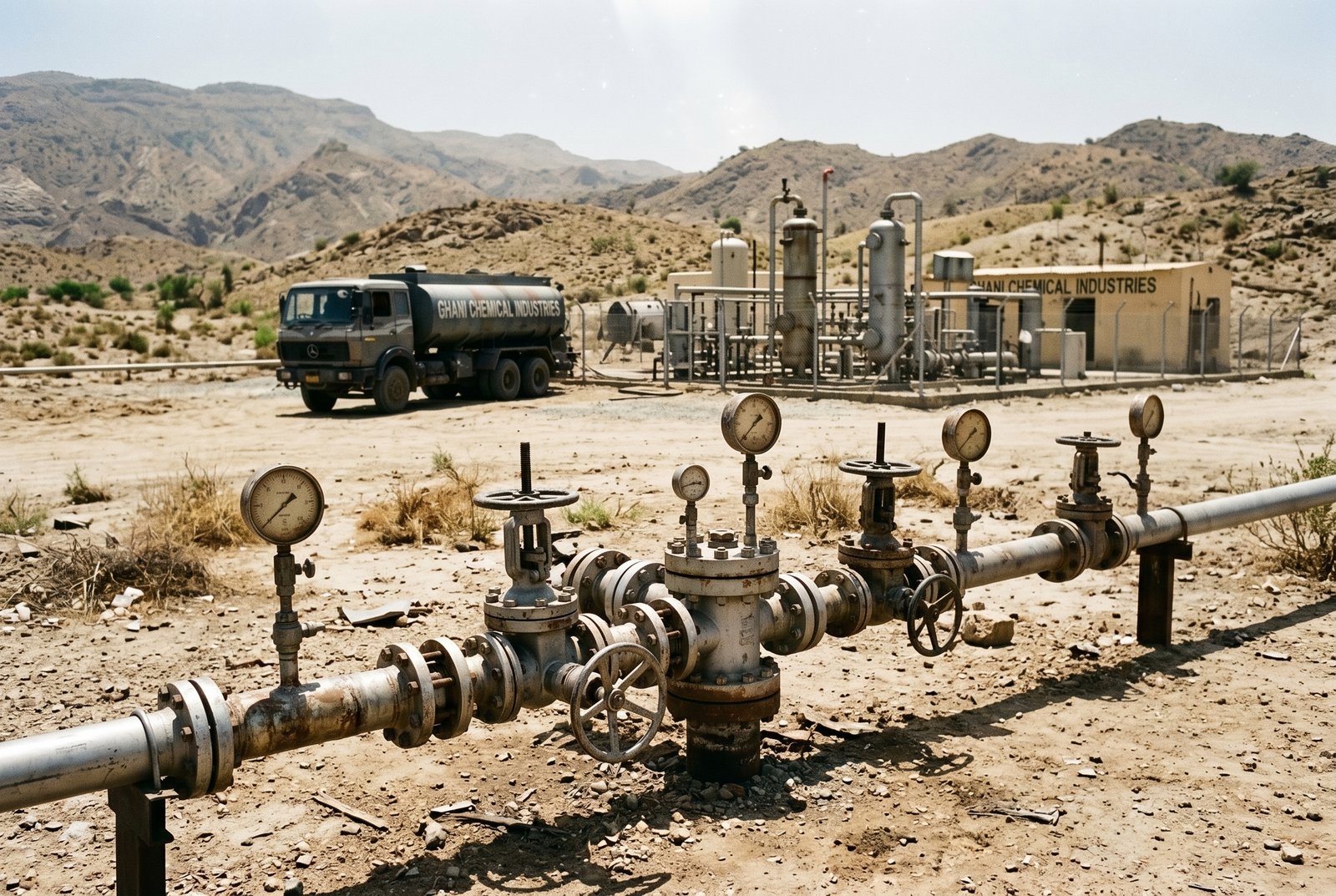
Pakistan’s capital markets are witnessing a highly unusual corporate finance maneuver. Ghani Chemical Industries, a leading supplier of industrial and medical gases, is preparing to raise Rs 1.16 billion through a novel class of preference shares. Rather than linking returns to the parent company’s overall profitability, these Class B Tracking Shares will tie investor dividends directly to the financial performance of three specific natural gas processing projects. This move breaks away from the conventional Pakistan Stock Exchange (PSX) model, where companies typically fund new ventures through corporate borrowing, ordinary equity dilution, or by spinning off entirely new listed subsidiaries.
From Atmospheric Gases to Energy Processing To contextualize this strategic pivot, it is essential to understand Ghani Chemical’s trajectory. As part of the Lahore-based Ghani Global Group, the company has steadily expanded its footprint in Pakistan’s industrial and healthcare supply chains. Between 2009 and 2019, the group launched three air separation units to process atmospheric air into commercial oxygen, nitrogen, and argon for hospitals, refineries, and steel manufacturers. After incorporating in 2015, Ghani Chemical absorbed the group’s gas manufacturing operations and officially listed on the PSX in 2022, subsequently adding a fourth unit at Port Qasim.
By 2025, the company launched a massive 275-tonne-per-day facility at the Hattar Special Economic Zone while carving out its calcium carbide operations into a separate entity to streamline its core focus. The company enters this new venture from a position of financial strength. For the fiscal year ending June 2026, revenue grew by 11 per cent to Rs 8.28 billion, and net income surged 43 per cent to Rs 2.86 billion, with gross profit margins expanding to over 53 per cent.
Monetizing Stranded Natural Gas Assets The proposed natural gas portfolio aims to monetize stranded domestic assets. Pakistan has a persistent energy infrastructure challenge where numerous domestic gas discoveries remain unutilized due to low pressure, remote locations, or the prohibitive capital expenditure required to connect them to the national pipeline grid. Ghani Chemical’s strategy bypasses the pipeline entirely by building processing facilities directly at the wellheads and transporting the commercialized products by road.
The smallest project, located at the Sono Lashari field in Sindh, will require an estimated Rs 557 million investment to process one million cubic feet of gas per day into compressed natural gas, liquefied petroleum gas, and natural gas liquids. A larger Rs 2.15 billion project at Maiwand in Balochistan will process three million cubic feet daily into 46 tonnes of liquefied natural gas (LNG). The largest undertaking, the Rs 3.31 billion Jandran project in Balochistan, targets a daily output of 84 tonnes of LNG. Ghani Chemical projects robust returns across the board, with the smaller Sono Lashari site expected to generate an internal rate of return near 100 per cent, while the larger Balochistan projects are projected to deliver a combined Rs 10 billion in first-year revenue with a post-tax return of 34 per cent.
Read More: Pakistan Eyes $2 Billion Dairy Export Target By 2035 Through Sweeping Market Liberalisation
The Financial Architecture of Tracking Shares To execute this Rs 6.02 billion portfolio, Ghani Chemical has formed a special-purpose vehicle named G3 Oil & Gas Conversion LLP. The financing relies on Rs 4 billion in project debt and Rs 2.01 billion in equity. Ghani Chemical holds an 84 per cent economic interest in this partnership, funding its share through Rs 850 million from internal reserves and the remaining Rs 1.16 billion via the new Class B Tracking Shares.
Investors purchasing these tracking shares, priced at Rs 10 each, will not receive a fixed annual yield. Instead, they are collectively entitled to nearly 58 per cent of the net cash distributions that Ghani Chemical actually receives from the project vehicle. The shares feature an unusual structure where Rs 9 of the nominal value is redeemable, and voting power is diluted so that five tracking shares equal the voting weight of one ordinary share. Furthermore, the tracking shares must be converted to ordinary shares within ten years, or earlier if dividend failures occur.
Global Precedents and Local Execution Risks While unprecedented on the PSX, tracking shares are a recognized instrument in American capital markets. Telecommunications giants like Sprint and media conglomerates like Liberty Media have historically utilized tracking stocks to isolate the financial performance of distinct assets before eventually spinning them off. However, Ghani Chemical’s Pakistani adaptation is distinct. Instead of using common stock whose value fluctuates based on market sentiment toward a division, these are preference shares with a dividend mathematically tethered to the physical cash distributions of a legally ring-fenced project vehicle.
While the structure shields Ghani Chemical from immediate ordinary equity dilution, it shifts complex analytical burdens onto investors. The tracking shares do not grant direct ownership of the partnership. If the gas projects generate massive paper profits but retain all their cash to pay down the project debt, tracking shareholders receive nothing. Furthermore, the operational risks are severe, requiring the company to verify wellhead gas quality, construct complex liquefaction plants on time, and secure highly specialized LNG road-transport logistics. There is also systemic risk to the parent company, which intends to provide up to Rs 4 billion in corporate guarantees to back the project debt.
If Ghani Chemical successfully navigates these hurdles, this issuance could revolutionize the PSX. It would provide a verified blueprint for major industrial conglomerates to raise risk-isolated capital for distinct mega-projects without fracturing their corporate structures or spinning off new entities.