
KARACHI, November 29, 2026: Former caretaker federal minister and prominent industrialist Dr Gohar Ejaz has thrown his weight behind United Business Group (UBG) presidential candidate S.M. Tanveer ahead of the Federation of Pakistan Chambers of Commerce and Industry (FPCCI) elections, revealing the circumstances that led to the collapse of efforts to unite rival business groups under a broader electoral alliance.
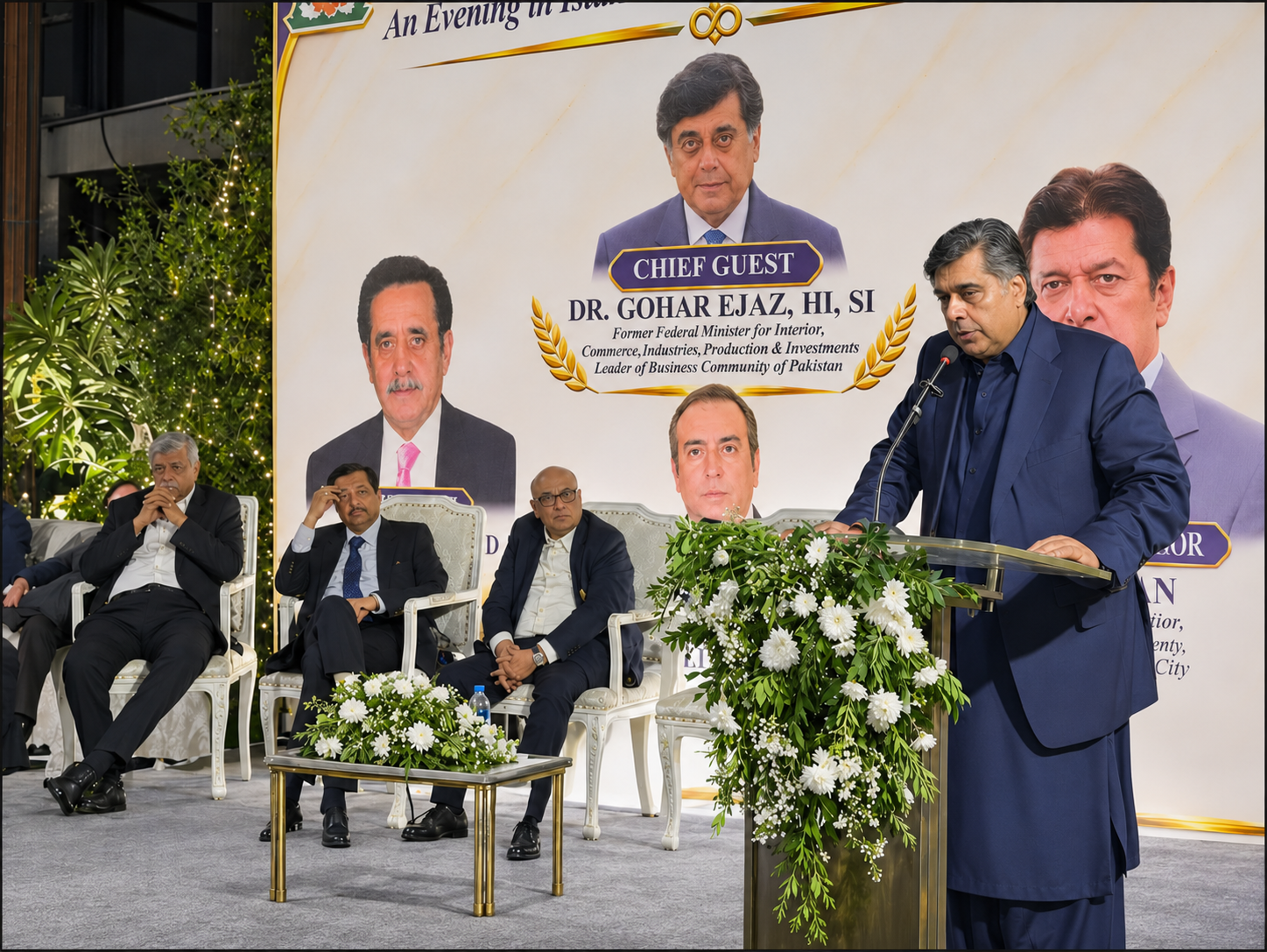
Speaking as the guest of honour at a dinner hosted on Saturday night by former Karachi Chamber of Commerce and Industry (KCCI) president Shaukat Ahmed, Ejaz delivered a wide-ranging address covering business community politics, the importance of honouring commitments, Tanveer’s eligibility for the FPCCI presidency and Pakistan’s economic future.
His remarks came at a crucial stage in the electoral process, with the deadline for submission of nomination papers approaching and polling scheduled for December 17, 2026.
Merit-Based Selection of Candidates
Ejaz explained that a structured mechanism had been established to ensure that candidates contesting the FPCCI elections were selected on merit rather than personal preferences or pressure from individual business groups.
The selection committee, headed by veteran industrialist Bashir Jan Mohammad, included UBG President Zubair Tufail, UBG Sindh Chairman Khalid Tawab and Businessmen Panel Progressive (BMPP) Chairman Saquib Fayyaz Magoon.
According to Ejaz, the committee had been given complete authority to evaluate nominations and select the most suitable candidates.
He emphasised that nominations submitted by individual groups were not automatically binding on the committee, which had been entrusted with identifying candidates capable of effectively representing Pakistan’s business community.
The objective, he said, was to establish an institutional mechanism that placed collective interests above individual ambitions.
Why the Broader Alliance Failed
Ejaz revealed that he had personally advocated reconciliation between rival business groups, arguing that Pakistan’s business leadership could not afford to remain permanently divided over electoral positions.
He said that despite the limited electoral strength of the Businessmen Panel (BMP) in the previous contest, he had approached its leadership, including Mian Anjum Nisar, in an effort to establish equitable representation.
“We are all brothers and what we represent are business issues rather than personal issues,” Ejaz said.
He argued that repeated electoral confrontations consumed valuable time and resources that should instead be devoted to addressing economic challenges, influencing government policies and improving the country’s business environment.
Ejaz disclosed that Bashir Jan Mohammad, Sheikh Riaz and he had continued their reconciliation efforts until the final stages of negotiations.
However, according to Ejaz, the fundamental obstacle was not the distribution of positions but a breakdown of trust arising from an earlier agreement concerning the Lahore Chamber of Commerce and Industry (LCCI).
Lahore Chamber Agreement Became a Stumbling Block
Ejaz alleged that an earlier arrangement between Anjum Nisar and the group associated with Ali Hussam Asghar envisaged a rotational presidency of the Lahore Chamber, under which each side would hold office for two years.
According to Ejaz, Nisar subsequently declined to honour the second part of the arrangement, prompting concerns among UBG leaders.
Ejaz said he had intervened through former FPCCI president Nasir Hayat Maggo, forwarding the agreement and questioning why the agreed transfer of leadership was not being implemented.
He recalled warning that failure to honour the Lahore Chamber arrangement could have serious repercussions for any future agreement at the federation level.
The subsequent Lahore Chamber elections resulted in a victory for the UBG-backed camp, with Ali Hussam Asghar assuming the presidency.
Ejaz said Asghar, Momin Malik and S.M. Tanveer subsequently questioned how a proposed 50-50 power-sharing arrangement at the FPCCI could be trusted when an earlier written commitment had allegedly not been honoured.
Although Ejaz had been approached to act as an arbitrator, he said he ultimately declined to guarantee the implementation of an agreement whose performance depended on other individuals.
“I could not guarantee the performance,” he said.
S.M. Tanveer’s Honesty Is His Greatest Strength
In a particularly significant endorsement, Ejaz described Tanveer’s straightforward approach and commitment to speaking the truth as among his greatest strengths.
“S.M. Tanveer has a great weakness – he speaks the truth,” Ejaz remarked, explaining that what some might consider a disadvantage in electoral politics was, in his view, an essential leadership quality.
He said the business community required leaders who honoured their commitments rather than entering into arrangements merely to secure positions.
Ejaz maintained that there was nothing inherently wrong with democratic electoral competition and that those commanding majority support should be allowed to lead.
However, he cautioned against transforming institutional elections into personal rivalries, blame games and unnecessary controversies.
Gohar Ejaz Dismisses Objections Over Tanveer’s Sindh Credentials
Addressing objections surrounding Tanveer’s candidature during Sindh’s rotational term for the FPCCI presidency, Ejaz offered a detailed explanation of his corporate and institutional affiliations.
He argued that the federation’s membership comprised chambers and trade associations rather than individuals, while the constituent organisations represented businesses and corporate entities through their authorised nominees.
Ejaz pointed out that Tanveer was the chief executive of Din Textile Mills Limited, a publicly listed company incorporated in 1988 and headquartered in Karachi.
Pakistan Stock Exchange records also identify Tanveer as the company’s chief executive and list its corporate address in Karachi.
Ejaz recalled that Tanveer’s father, the late S.M. Muneer, had assigned his son responsibilities at the family’s manufacturing operations in Punjab, as was common among industrial families.
He questioned whether managing a manufacturing facility in another province could reasonably negate an individual’s longstanding corporate and family association with Karachi.
Ejaz maintained that Tanveer’s corporate affiliation and representation through the relevant trade association provided the basis for his candidature.
Pakistan Needs Growth, Not Currency Devaluation
Moving beyond electoral politics, Ejaz outlined what he described as the fundamental economic priorities that the incoming FPCCI leadership must pursue.
These included export expansion, import substitution, industrialisation, capital formation, employment creation and greater private-sector investment.
“Currency devaluation is not the solution to economic issues. There is only one solution for us and that is growth,” he said.
Ejaz argued that exchange rate stability must now be accompanied by policies that encourage productive investment rather than excessive dependence on interest income.
Citing figures during his address, he said funds held in Pakistan’s banking system had increased from approximately Rs23 trillion in 2023 to around Rs42-43 trillion, while the exchange rate had remained broadly stable.
He expressed concern that a growing preference for earning returns through bank deposits was discouraging entrepreneurial activity and industrial expansion.
He questioned why Pakistan, with its considerable industrial and entrepreneurial potential, was not doing more to channel domestic capital towards productive businesses.
An Eight Per Cent Incentive for Exporters
Ejaz also questioned Pakistan’s dependence on expensive external financing, referring to what he described as a recent $3 billion borrowing arrangement carrying an interest rate of eight per cent.
While acknowledging the country’s immediate financing requirements, he argued that comparable fiscal support could instead be considered for domestic manufacturers and exporters.
He proposed an eight per cent export drawback or comparable incentive to improve the international competitiveness of Pakistani products, generate foreign exchange and encourage industrial expansion.
Such measures, he argued, could help Pakistan gradually reduce its dependence on external borrowing by strengthening its own foreign exchange earning capacity.
Ejaz stressed that sustainable economic sovereignty could only be achieved through production, exports and investment rather than borrowing alone.
Ejaz Praises Punjab’s Business Financing Initiatives
The former federal minister also appreciated the Punjab government’s subsidised and interest-free business financing initiatives, calling for similar programmes to be introduced across all provinces.
He advocated affordable financing for entrepreneurs, small and medium enterprises and industrial investors, alongside tax incentives to encourage investment in listed companies.
Such policies, he said, could strengthen Pakistan’s capital markets, promote entrepreneurship, mobilise domestic savings and create employment opportunities.
A Federation Focused on Pakistan’s Economic Future
Ejaz concluded by urging candidates contesting the FPCCI elections to present a comprehensive economic vision rather than limiting their campaigns to electoral arithmetic and personal disagreements.
He said the federation’s true strength lay in the unity of Pakistan’s business community and its ability to collectively advocate policies that promoted investment, exports, industrial competitiveness and job creation.
His address underscored that the forthcoming FPCCI elections must ultimately be about more than determining who occupies the federation’s presidency for the next two years.
For Ejaz, the greater challenge is transforming Pakistan from an economy dependent on borrowing and interest income into one driven by entrepreneurship, industrial production, investment and sustainable economic growth.
He concluded his address with prayers for Pakistan’s prosperity, progress and economic wellbeing, declaring: “Pakistan Zindabad.”