

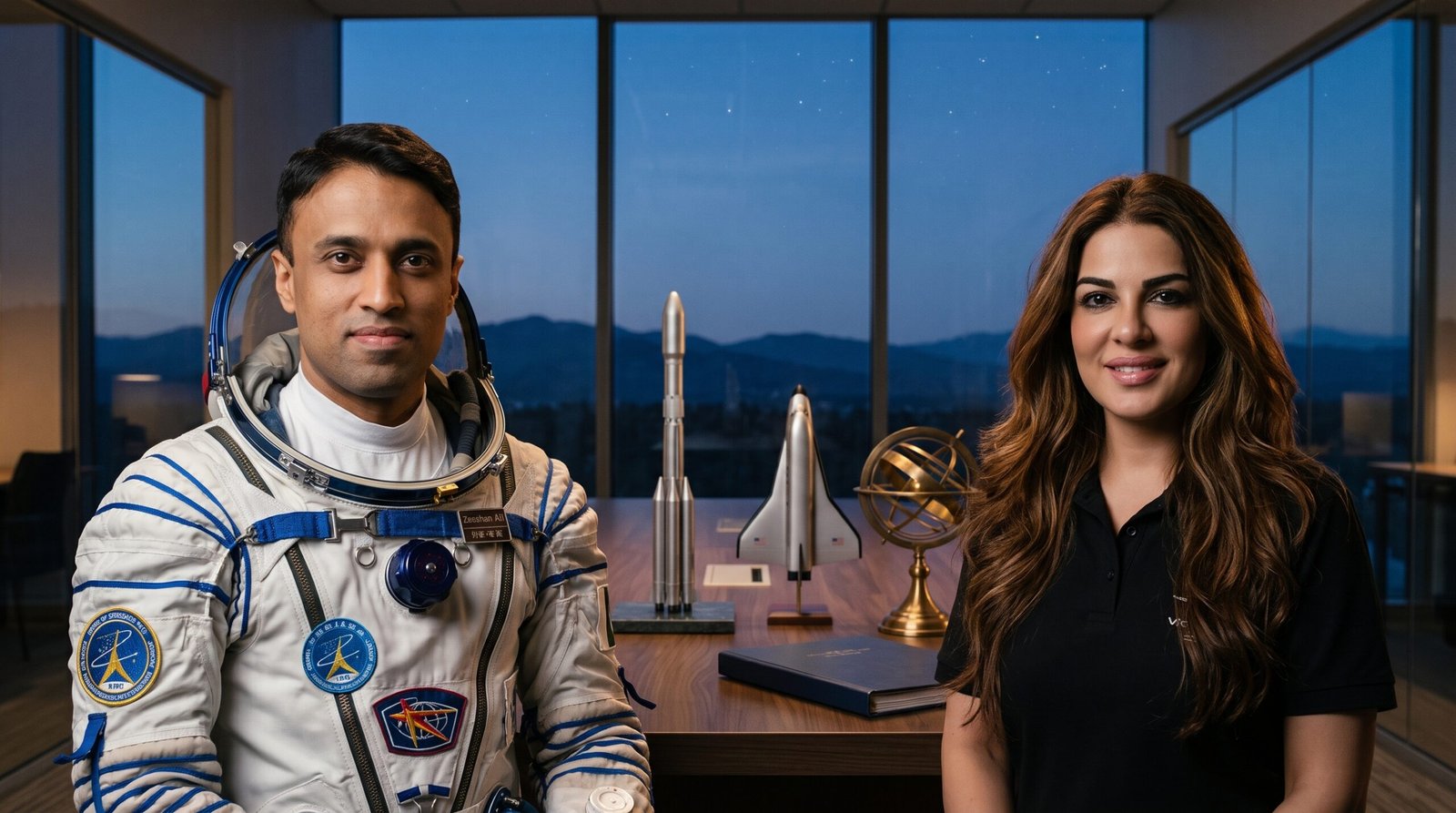
ISLAMABAD: Pakistan is celebrating a landmark moment in its space history following the arrival of Muhammad Zeeshan Ali at China’s Tiangong space station, yet the historic voyage has simultaneously reignited a spirited public debate over who truly holds the title of the country’s first astronaut.
Ali, a 40-year-old Pakistan Air Force (PAF) pilot, entered the record books on November 25, 2026, lifting off aboard China’s Shenzhou-24 spacecraft atop a Long March-2F rocket from the Jiuquan Satellite Launch Centre in northwestern China alongside Chinese commander Tang Hongbo and flight engineer Wu Yi. By reaching Tiangong, Ali became the first Pakistani to enter Earth’s orbit, the first foreign national ever to visit China’s orbiting space station, and the first Pakistani selected to participate in Beijing’s crewed space programme under the bilateral astronaut cooperation agreement signed between Pakistan’s Space and Upper Atmosphere Research Commission (SUPARCO) and the China Manned Space Agency (CMSA) in February 2025.
Yet celebrating Ali as Pakistan’s “first astronaut” carries a notable complication: another Pakistani citizen had already crossed into space more than three years earlier.
Namira Salim Pushes Back Against Overlooking Her 2023 Flight
That earlier milestone belongs to Karachi-born adventurer Namira Salim, who flew aboard Virgin Galactic’s commercial Galactic 04 mission on October 6, 2023, reaching a peak altitude of approximately 87.4 kilometres before gliding back to Earth.
Following the widespread description of Ali as “Pakistan’s first astronaut,” Salim has pushed back firmly, stressing that she was formally recognised by the Government of Pakistan under that very title nearly two decades ago. Speaking to Independent Urdu, she recalled that the Ministry of Information and Broadcasting officially introduced her to the nation as Pakistan’s first astronaut in 2006, after she purchased her ticket and joined Virgin Galactic’s inaugural cohort of founding astronauts. Although she signed on in 2006 and completed suborbital centrifuge training the following year, it took nearly 18 years for the US-based private spaceflight company to complete test flights, regulatory clearances, and safety procedures before commercial missions became operational.
While welcoming Ali’s achievement and acknowledging that launching Pakistan’s formal human spaceflight programme in collaboration with China is a positive and comparatively cost-effective step forward, Salim insisted that her pioneering effort must not be erased. “First Pakistani astronaut is Namira Salim, that’s me,” she stated, adding, “A plethora of people dream of going into space, may their dream come true. I have set this example [of going into space] and will keep doing so and if my work benefits others then it is the biggest reward for me.”
Addressing concerns over state recognition, Salim was equally blunt. “If the government overlooks this [feat] and ignores efforts of a private citizen, then it’s its own problem,” she remarked. She also sought to dispel any doubts regarding her nationality, noting that even the interim government had formally acknowledged her milestone in 2023. “I want to clarify here that even though I live outside Pakistan but I have no other passport than Pakistani,” she clarified.
Suborbital Versus Orbital: The Technical Divide
At the heart of the controversy lies a fundamental aerospace distinction: the type of spaceflight each pioneer undertook.
Salim travelled on a suborbital commercial flight. During Virgin Galactic’s mission profile, the winged spacecraft is carried aloft beneath a carrier mothership to a high altitude before separating and igniting its hybrid rocket motor. The vehicle climbs steeply past the US-recognised threshold of space, provides passengers with several minutes of weightlessness and panoramic views of Earth’s curvature, and then glides back down to a runway landing. Crucially, however, a suborbital vehicle does not achieve the immense velocity required to enter a sustained orbit around the planet.
Ali’s mission aboard Shenzhou-24, by contrast, is a state-backed orbital spaceflight. Launched into low-Earth orbit by a multi-stage orbital rocket, his spacecraft rendezvoused and docked with China’s three-module Tiangong space station. Flying as a trained payload specialist alongside Chinese taikonauts, Ali is spending days in microgravity installing and conducting scientific experiments and participating in formal space station operations. Put simply, Salim travelled to the edge of space and returned minutes later, whereas Ali entered Earth’s orbit and lived and worked aboard an operational orbital laboratory.
Where Does Space Begin? The 80.5-Kilometre and Kármán Line Debate
Compounding the debate is an unresolved technical question in international aerospace: there is still no single, universally codified altitude at which Earth’s atmosphere ends and outer space begins.
In the United States, NASA, the US Air Force, and the Federal Aviation Administration recognise 50 miles (approximately 80.5 kilometres) above Earth as the boundary of space. By contrast, the Fédération Aéronautique Internationale (FAI)—the Swiss-based body that governs international aeronautical and astronautical records—recognises the Kármán line at 100 kilometres above sea level, the approximate altitude where the atmosphere becomes too thin to support conventional aerodynamic lift.
Because Salim’s Galactic 04 flight reached an apogee of 87.4 kilometres, she crossed the US-recognised boundary of space but fell short of the internationally referenced 100-kilometre Kármán line. Ali’s orbital trajectory aboard Shenzhou-24, meanwhile, carried him hundreds of kilometres above Earth, clearing both thresholds by a wide margin.
Two Distinct Firsts in Pakistan’s Space Journey
Ultimately, framing the conversation as a zero-sum contest obscures the significance of both achievements. The most accurate and fair distinction recognises that Namira Salim was the first Pakistani to travel to space via private suborbital spaceflight, while Muhammad Zeeshan Ali is the first Pakistani to enter Earth’s orbit, dock with a space station, and fly as part of a state-backed national human spaceflight mission.
Rather than diminishing either pioneer, the debate reflects how rapidly the global definition of an “astronaut” is evolving in an era where commercial space tourism increasingly coexists alongside government-led orbital exploration. For Pakistan, both milestones occupy their own permanent chapter in the country’s unfolding journey beyond Earth.