

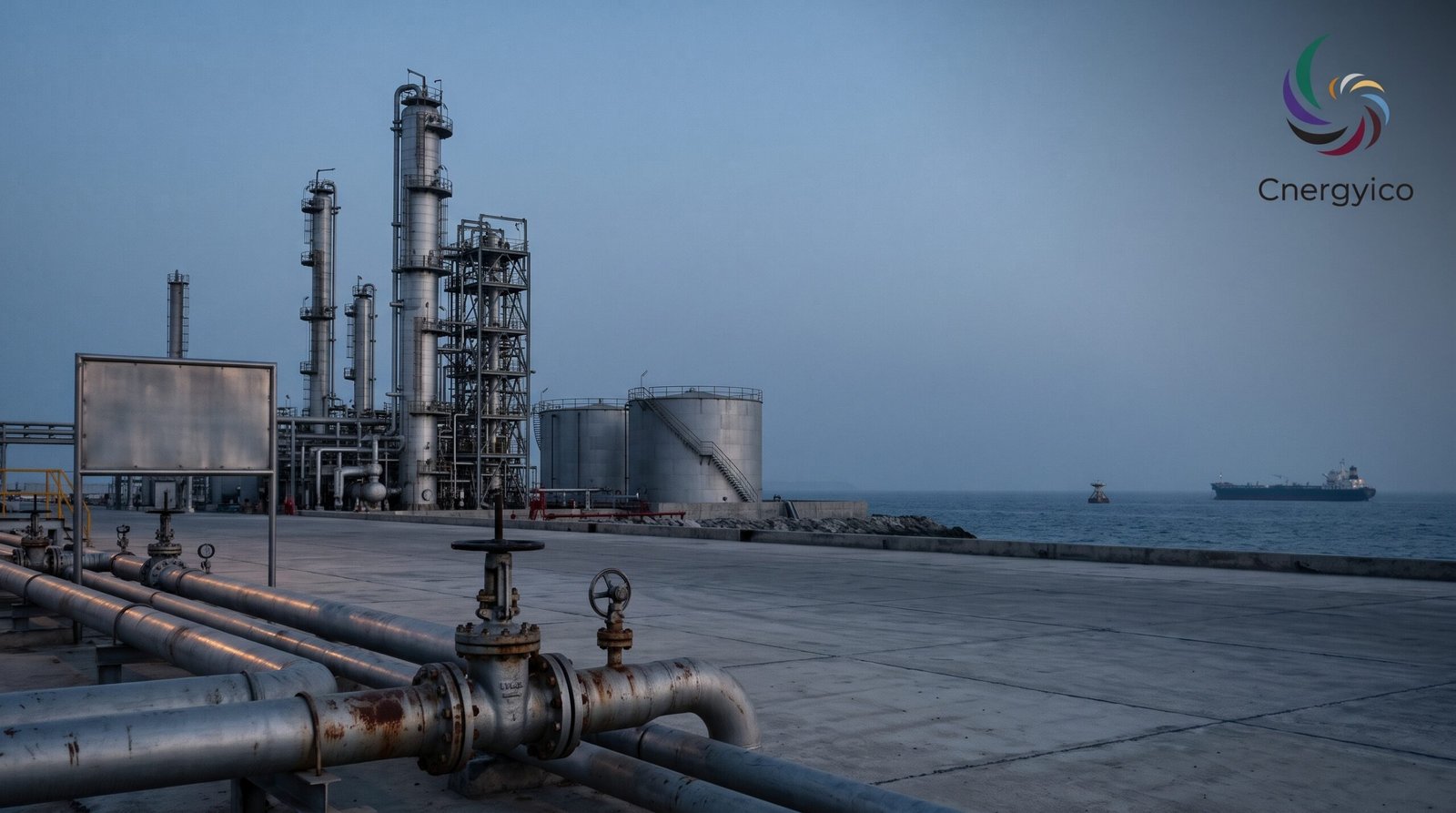
Pakistan’s largest oil refiner, Cnergyico PK Limited (CNERGY), is pursuing $150 million to $300 million in external project financing to underwrite a multi-year refinery modernization estimated to cost between $1.2 billion and $1.5 billion, holding discussions with the US Export-Import Bank (EXIM Bank), the US International Development Finance Corporation (DFC), and Middle Eastern lenders.
According to corporate briefing takeaways issued by Topline Pakistan Research, Cnergyico’s management projects that under the $1.2 billion capital expenditure scenario, roughly $300 million will be generated through “customs duty incentives” under Pakistan’s refinery policy, with sponsors and commercial or multilateral lenders supplying the remaining $900 million.
The capital program is structured across three sequential phases. Phase one targets upgrading motor spirit (petrol) and high-speed diesel (HSD) output to “Euro-V specifications”, phase two focuses on furnace oil conversion, and phase three covers refining capacity expansion alongside port infrastructure upgrades. Management asserted that Cnergyico leads domestic peers in upgrade execution and disclosed preliminary talks with investors to construct a second “single-point mooring” (SPM) facility to support refined product exports.
“Meanwhile, the company expects Rs30–35 per litre of the Rs49 per litre surrendered under the revised motor spirit (MS) pricing formula to affect its profit and loss account.”
Near-term earnings, however, face acute regulatory pressure. Management warned that Rs30 to Rs35 per litre of the Rs49 per litre surrendered under the government’s revised “motor spirit (MS) pricing formula” will flow directly through to Cnergyico’s profit and loss statement, while the residual balance reduces customs duty inflows earmarked for the dedicated “refinery upgrade account”.
Company officials noted that unlike earlier adjustments to diesel pricing, authorities enacted the petrol formula revision without consulting domestic refiners. With petrol refining margins already in negative territory, management expects the revised mechanism—initially introduced for one month—to lapse, cautioning that an extension could compel refiners to curtail crude throughput. Across the sector, refiners intend to escalate the dispute to the “anomaly committee” established under the “upgrade agreement” before considering formal arbitration.
Also Read: Federal Cabinet Approves Sugar Sector Deregulation To Meet Delayed IMF Structural Benchmark
Cnergyico also expects federal regulators to lift the $38-per-barrel ceiling on “crack spreads” once benchmark averages remain below that threshold, in line with prior precedent. Management advocated permanently abolishing the cap to improve operational forecasting and allow refiners to execute commercial hedging strategies. On diesel, the company noted that the 7.5% “deemed duty” embedded in HSD pricing is not being fully recovered, forcing refiners to offset the shortfall via customs duties collected on petrol.
“Cnergyico significantly diversified its crude sourcing during FY26, procuring 48% of its supplies from the United States, 25% from Africa, 21% from the Middle East and 6% from the Caspian region.”
Operational disclosures highlighted a sweeping overhaul of Cnergyico’s crude oil supply chain during FY26, pivoting heavily away from traditional Middle Eastern barrels toward Atlantic Basin grades driven strictly by refining margin economics.
| Crude Oil Sourcing Region | FY25 Share | FY26 Share | YoY Shift |
| United States | 0% | 48% | +48 percentage points |
| Africa | 0% | 25% | +25 percentage points |
| Middle East | 72% | 21% | -51 percentage points |
| Caspian Region | 28% | 6% | -22 percentage points |
Delivered spot crude premiums currently average $6 to $8 per barrel, while Cnergyico incurs an additional landed cost of $20 to $22 per barrel on West Texas Intermediate (WTI) shipments. Management expects marine freight rates to stay elevated through December before easing in January.
The shift toward low-sulphur US and West African crudes underpins Cnergyico’s ability to manufacture very low sulphur fuel oil (VLSFO), which currently trades at a roughly $300 per tonne premium over high sulphur fuel oil (HSFO). While no US crude cargoes have been booked for December and January, Cnergyico has locked in West African shipments to sustain VLSFO output.
On commercial volumes, Cnergyico posted the highest diesel sales across Pakistan’s refining industry in October, narrowly edging out Pak-Arab Refinery Limited (PARCO) on the strength of carried-over inventory. November dispatches softened, with management anticipating inventory losses amid falling international fuel prices.
Finally, on legacy balance-sheet items, Cnergyico expects a Rs3 billion accounting write-back linked to the “Balochistan cess” alongside the release of previously posted financial guarantees. Separately, a Rs4 billion penalty assessed under the “refinery upgrade agreement”—stemming from a reduction in deemed duty from 7.5% to 5%—has already been booked in FY26 financial statements and settled after September.