

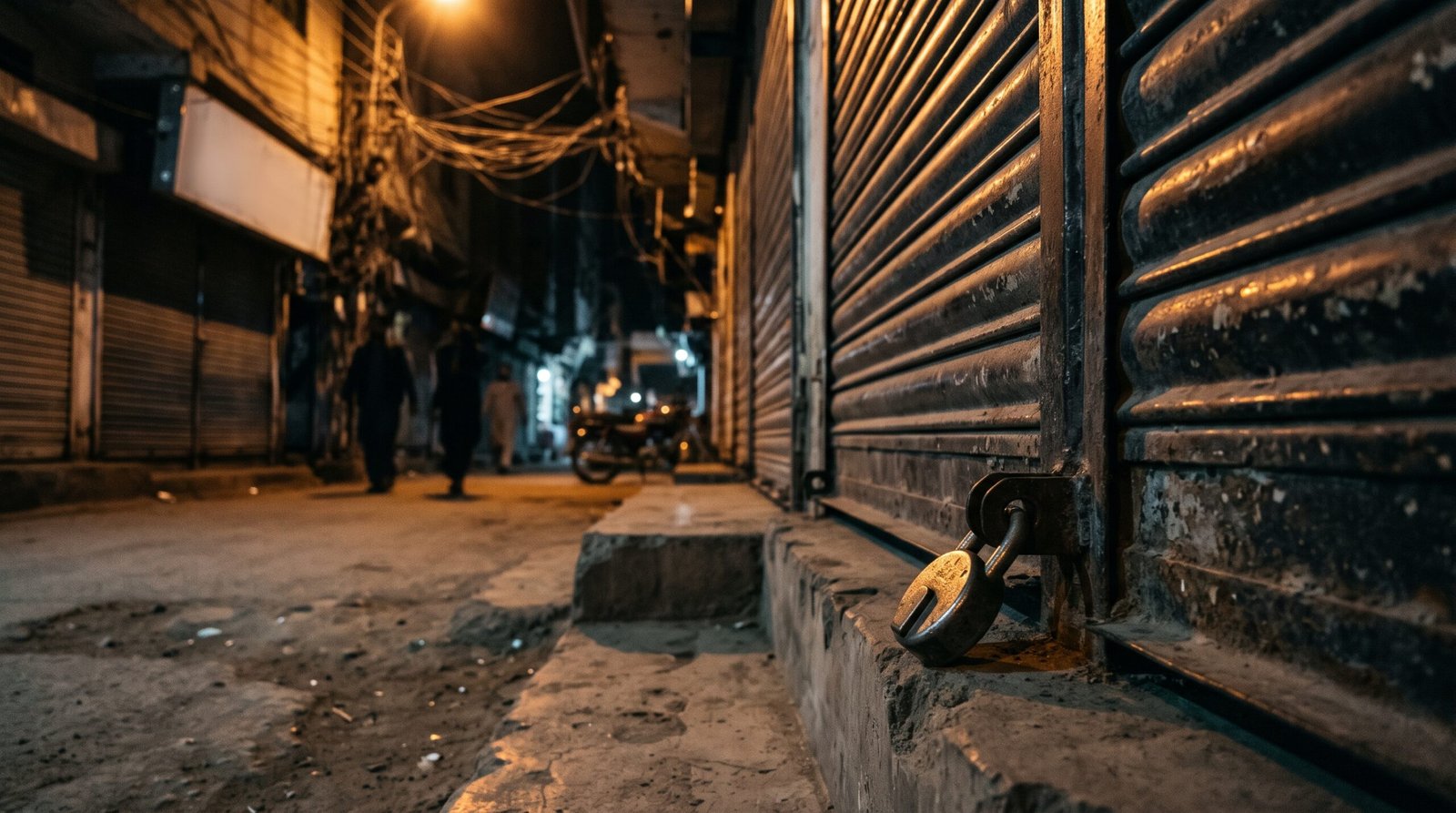
LAHORE: The federal government’s mandate requiring early shop closures has severely disrupted Pakistan’s retail sector, triggering a 42% drop in daily customer transactions without delivering conclusive evidence of the intended energy savings.
According to a new nationwide study conducted by research firm Ipsos and presented by the Chainstore Association of Pakistan, the 9 pm closure rule has forced retailers to slash their operating hours by an average of 1.6 hours per day, bringing total daily trading down from 11.2 to 9.6 hours. The fieldwork, conducted between August and September 2026 across 53 markets and malls in 10 cities, paints a stark picture of a sector struggling to adapt to restrictive trading windows.
Financial Toll On Retailers
The contraction in trading hours has directly hollowed out sales volumes across the top 10 major product categories. The average number of daily transactions per shop has plummeted from 86 to just 50. The footwear and apparel segments have been hit particularly hard; daily footwear transactions crashed from 85 to 38. According to industry executives, 40% to 50% of peak footfall for apparel brands traditionally occurs between 7 pm and 9 pm.
This loss of peak trading has devastated business sentiment. The share of retailers rating their overall sales as “good” has collapsed from 79% prior to the rule to just 34% today. Similarly, businesses reporting high profitability dropped from 67% to 26%. Evening footfall between 4 pm and 8 pm has also halved, dropping from 63% to 32%.
In response, the retail sector is undergoing forced structural adjustments. Approximately 73% of shops now open earlier in the day to compensate for lost evening hours. Another 34% have introduced or expanded their e-commerce operations, while 12% have been forced to lay off staff to manage mounting overheads.
Also Read: Pakistan’s Cost Of Living Crisis Deepens As Cooking Gas Surges 83% And Basic Staples Skyrocket
Energy Savings Fall Short Of Expectations
While the policy was explicitly introduced to conserve national electricity, the data indicates a massive disconnect between the macroeconomic goal and retail realities. Although 56% of surveyed retailers believed the broader energy conservation goal was achieved, only 41% actually saw a reduction in their own utility bills.
In Punjab, Islamabad, and Balochistan—where the 9 pm restriction remains actively enforced after being lifted in Sindh and Khyber-Pakhtunkhwa in May 2026—only 31% of retailers reported lower electricity costs. Even among the minority of business owners who acknowledged energy savings, average daily transactions still plummeted by more than half, signaling that the financial cost of the policy heavily outweighs utility savings.
Consumer Habits Fundamentally Altered
The shortened trading window has alienated shoppers and altered long-standing consumer behaviors. Of the 1,046 consumers surveyed, 37% reported that their overall shopping experience has worsened, and 53% stated that finding time to shop has become significantly harder.
Shopping frequencies have consequently declined. The average number of monthly shopping trips dropped from 9.4 to 8.7. The impact is heavily gendered: women have cut their shopping trips by 19% (dropping from 7.2 to 5.8 trips per month), compared to a mere 3% reduction among men.
The data also points to the death of leisure shopping. The proportion of consumers who “rarely or never” shop for leisure surged from 74% to 87%, while those who rarely shop with their families rose from 62% to 71%. Post-8 pm shoppers evaporated from 9% to 4%. Convenience has overtaken destination retail, with neighborhood shops gaining market share (rising from 27% to 31% as the primary shopping format), while major shopping malls slipped from 8% to 6%.
Global Comparisons Highlight Policy Flaws
The Ipsos study benchmarked Pakistan against 15 other countries, revealing that restrictive operating hours are an anomaly. Alongside Pakistan, Bangladesh is the only other nation utilizing early retail closures specifically to save energy, having altered its timings seven times since April.
Conversely, benchmark nations allow malls to operate until 10 pm or later. Countries like Brazil, France, Indonesia, the Philippines, and the UAE have successfully reduced commercial power consumption through efficiency plans, quotas, and peak-hour tariffs without forcing businesses to shut down. Brazil achieved a power reduction of over 20% using electricity quotas, while retail efficiency measures in France saved approximately 15% without cutting into trading hours.
Industry stakeholders have strongly criticized the government’s unilateral approach. Out of 25 key informants interviewed, 10 explicitly noted that traders were never consulted prior to the policy’s implementation, resulting in uneven and heavy-handed enforcement. Business leaders stress that adjusting to new trading hours requires a four-to-six-week transition period—a window often disrupted by erratic policy reversals. Stakeholders are now urging the government to extend closing times to 10 pm or 11 pm and to target energy conservation directly through solar power adoption, electric vehicle integration, and the reduction of grid power leakage.