

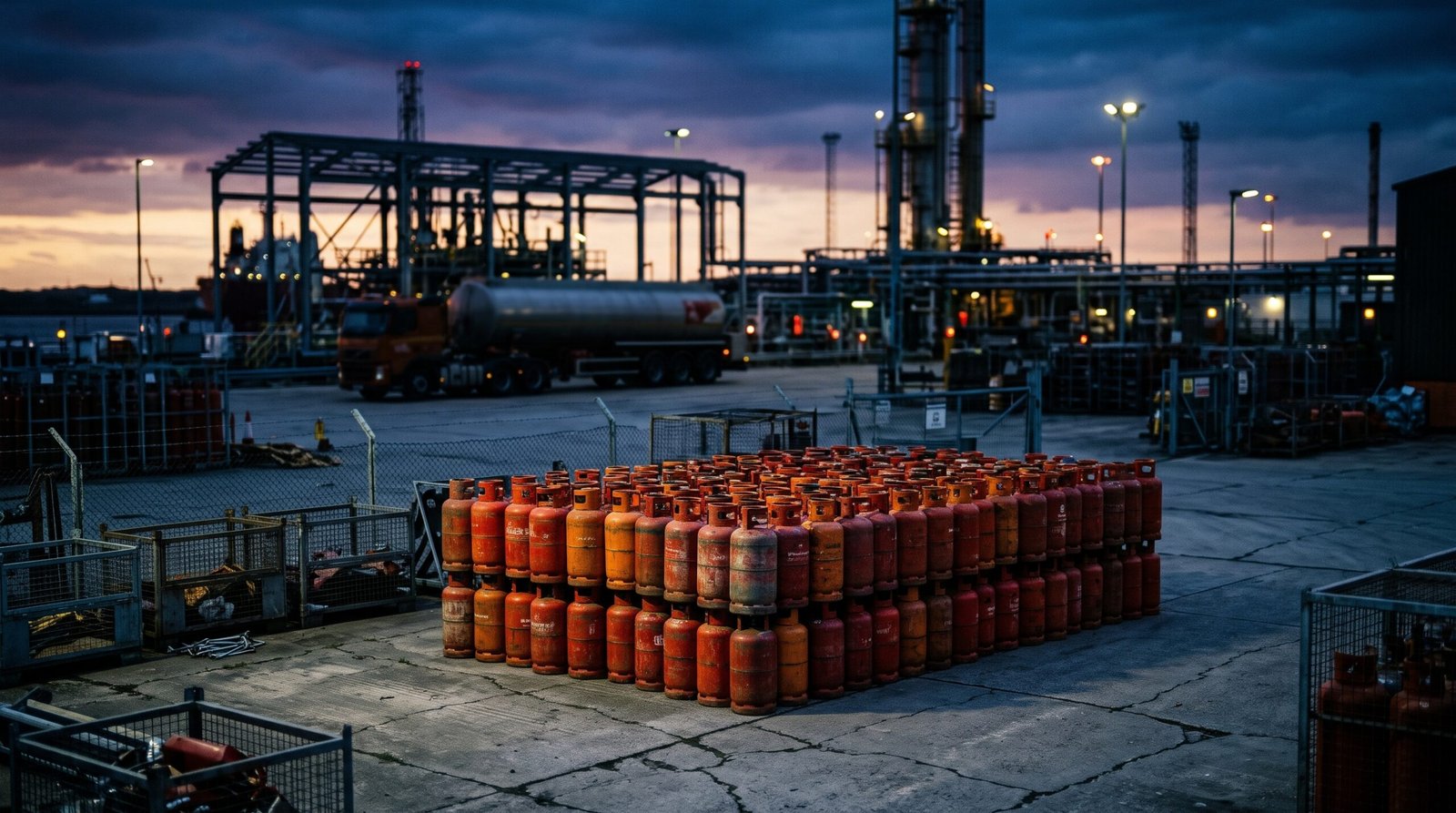
LAHORE: Pakistan is entering the winter of 2026–27 with an increasingly serious energy-security challenge, as domestic liquefied petroleum gas (LPG) cylinder prices have more than doubled in a year, imports have contracted sharply, and uncertainty surrounding natural gas and liquefied natural gas (LNG) supplies threatens to place further pressure on households, businesses and industry.
An examination by The Scoop of Pakistan Bureau of Statistics (PBS) figures, Customs import records compiled in an independent energy assessment, government winter gas projections and policy analyses prepared by energy specialist Asim Riaz and strategic analyst Dr Imran Nasir Sheikh reveals structural vulnerabilities that extend far beyond the closure of Pakistan’s western borders.
The crisis involves excessive dependence on Iranian supplies, inadequate strategic storage, limited marine-import infrastructure, outdated pricing arrangements, shortcomings in procurement planning, fragmented institutional responsibilities and a lack of coordination between the country’s LPG, LNG, natural gas and electricity sectors.
The most troubling question is whether the government could have anticipated the disruption and arranged replacement supplies before consumers were exposed to unprecedented prices.
In their jointly authored November 2026 assessment, Riaz and Sheikh argue:
“The central issue is not merely the disruption of an important fuel supply. It is the failure to prepare for a foreseeable threat to national energy security.”
Their assessment acknowledges the significance of the federal government’s recent LPG reform initiative while questioning why contingency procurement, alternative supply arrangements and storage improvements were not pursued earlier.
LPG Cylinder Prices Surge 115% In One Year
The latest PBS Sensitive Price Indicator figures provide a striking illustration of the crisis facing consumers.
According to official data for the week ending 5 November 2026, the national average retail price of an 11.67kg domestic LPG cylinder reached Rs6,497.89, compared with Rs3,023.99 during the corresponding week of November 2025.
This represents a year-on-year increase of 114.88%.
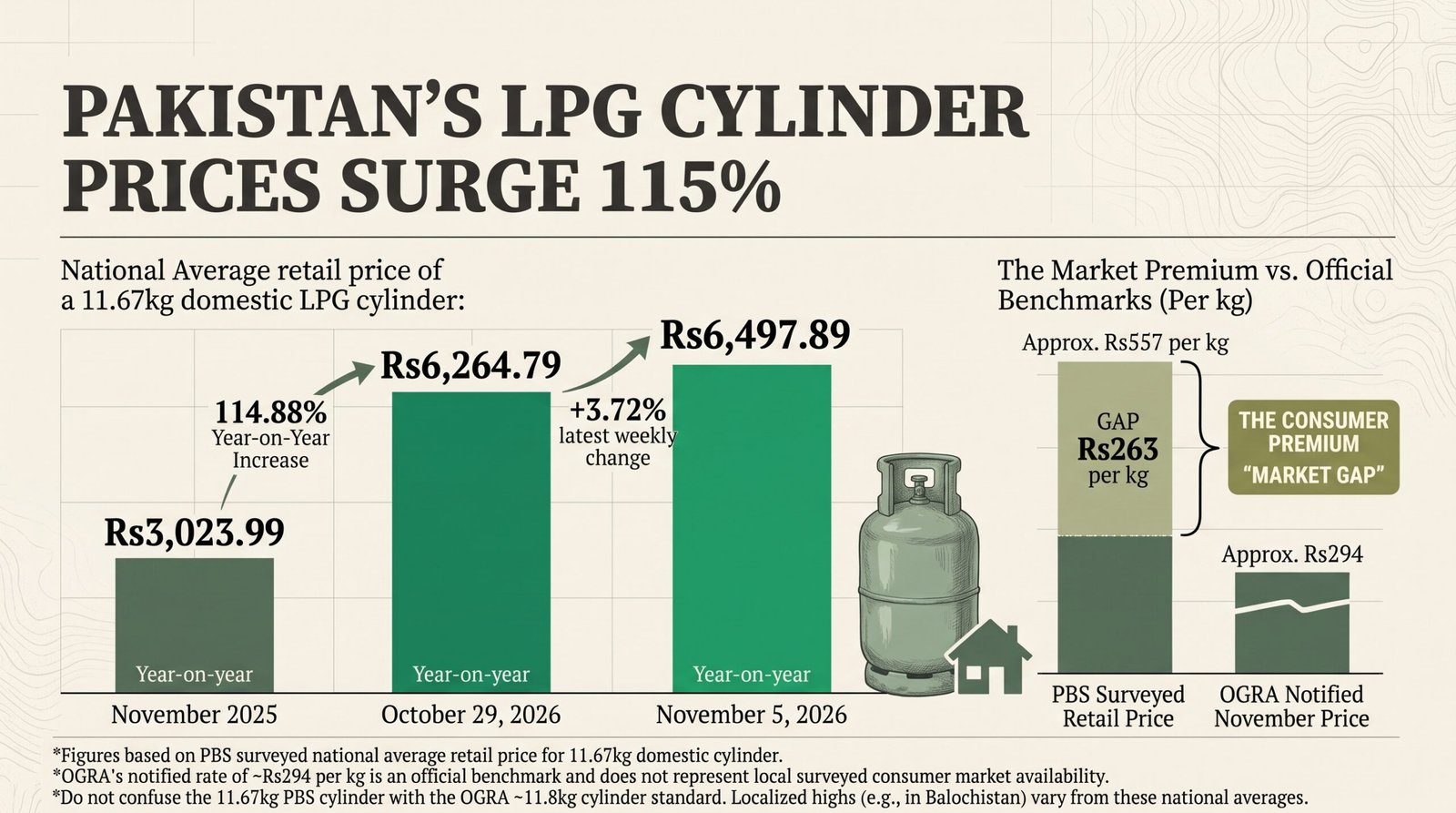
The price also increased by 3.72% in a single week, rising from Rs6,264.79 on 29 October.
At approximately Rs557 per kilogramme, the surveyed market price was substantially higher than the official LPG price notified by the Oil and Gas Regulatory Authority (OGRA).
For November, OGRA had notified a consumer price of approximately Rs294 per kilogramme, translating into roughly Rs3,470 for a standard 11.8kg domestic cylinder.
The difference illustrates a major weakness in the administered pricing system: the existence of an official ceiling does not guarantee that consumers can purchase LPG at that price.
The situation was even more alarming in certain markets.
Following the closure of the Taftan and Gabd-Rimdan border crossings on 17 October, traders reported that a 12kg cylinder in parts of Balochistan had risen from approximately Rs4,500 to Rs7,000.
At a press conference reported on 4 November, Federal Minister for Petroleum Ali Pervaiz Malik acknowledged that LPG was being sold for Rs700–800 per kilogramme in certain areas.
Such prices would put the cost of filling an 11.67kg cylinder at approximately Rs8,169–9,336, although these are calculations based on reported per-kilogramme rates rather than independently verified nationwide cylinder prices.
The distinction matters.
The PBS figure represents a weekly surveyed national average, while retail quotations during acute shortages can vary significantly by city, district, availability and individual dealer.
Consequently, the national price chart, dramatic as it appears, does not fully capture the temporary localised spikes immediately following the border closures.
Why Pakistan Depends On Iran For More Than Half Its LPG
Pakistan’s LPG market is estimated at approximately 2.4 million tonnes annually under the government’s official baseline, while some industry estimates place demand closer to 3 million tonnes.
The government’s indicative supply composition suggests that imports account for approximately 71% of national LPG availability.
Of total supply:
- Approximately 55% comes through Iranian land-border routes.
- Around 16% arrives through marine terminals.
- Domestic gas fields contribute approximately 20%.
- Refineries provide the remaining 9%.
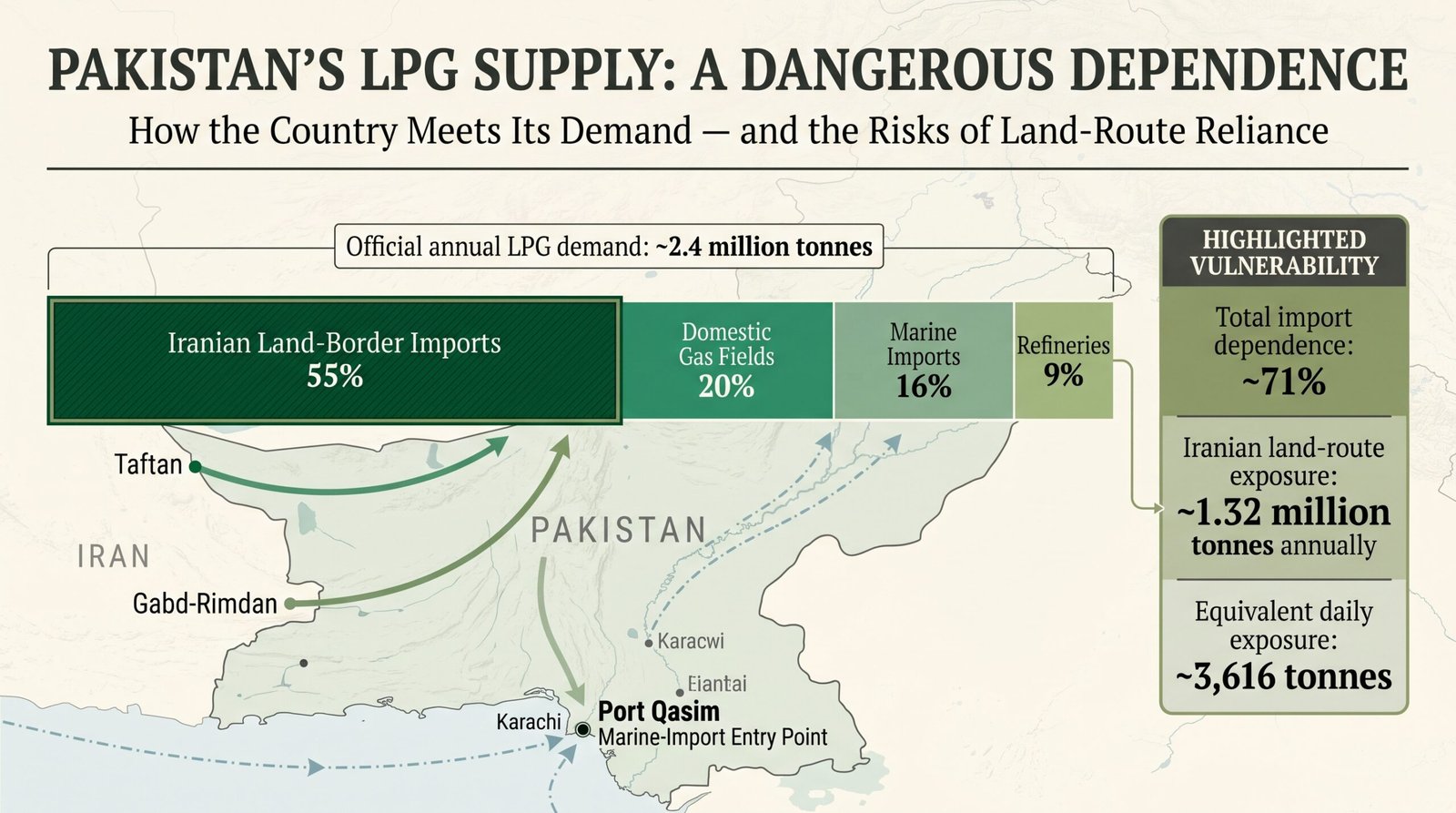
In other words, Pakistan depends on imported LPG for more than two-thirds of its requirements, with the majority of that dependence concentrated on one neighbouring country.
Applying the official percentages to the 2.4 million-tonne baseline suggests that approximately 1.32 million tonnes of LPG annually, or 3,616 tonnes per day, are exposed to Iranian land-route disruptions.
The country therefore faces a substantial supply-security risk whenever trade through Taftan, Gabd-Rimdan or associated routes is interrupted.
The independent assessment also identifies a methodological inconsistency requiring official reconciliation.
Another cited FY2025–26 baseline estimates indigenous production at approximately 960,000 tonnes and imports at 1.4 million tonnes. Those quantities differ materially from the figures implied by the government’s indicative 29% domestic and 71% import shares.
Differences in reference periods, Customs clearances, informal inflows, production measurements and inventory movements may help explain the discrepancy.
Until the datasets are reconciled, policymakers cannot claim to possess a fully consistent picture of national LPG availability.
The Warning Signs Emerged Months Before October
The October border disruption did not occur without warning.
Security problems affecting the Quetta–Taftan transport corridor had intensified from June 2026, exposing the vulnerability of tanker movements through Balochistan.
On 10 June, armed attackers reportedly set fire to six gas tankers near Nushki.
Subsequent attacks on tankers and freight movements along the N-40 highway further complicated the transportation of LPG from the Iranian border to domestic markets.
According to the analysts’ review of parliamentary proceedings, Customs officials informed a Senate standing committee on 11 August that approximately 40 tankers had been destroyed near Nushki, causing estimated losses of Rs2 billion.
Tanker movements were reportedly being conducted through escorted convoys, while supply was increasingly shifting away from Taftan towards alternative crossings.
Security officials were also reported to have warned that improvements could take several months.
This was an early indication that the supply problem could continue into winter.
The raising of FC Balochistan (West), with responsibilities covering the Taftan–Dalbandin–Nushki corridor, further demonstrated official recognition of the security challenges.
The analysts contend that measures addressing physical security were not matched by sufficiently early arrangements for replacement LPG imports.
Had alternative marine cargoes, storage availability, financing and inland logistics been secured during August or September, the impact of the October disruption might have been reduced.
That remains an important counterfactual rather than proof that sufficient replacement cargoes were commercially available at the time.
October Border Closure Exposes National Vulnerability
On 17 October 2026, the Gabd-Rimdan and Taftan crossings were closed, disrupting routes responsible for a substantial portion of Pakistan’s imported LPG.
Pakistani authorities cited security and anti-smuggling concerns, while Iranian officials referred to technical problems.
The interruption left hundreds of trucks stranded and created uncertainty for traders and importers.
Although a partial reopening occurred later in October, the return of normal freight and LPG movements was not immediate.
According to the independent assessment, Gabd had recorded LPG movements averaging approximately 3,500 tonnes daily during September.
At that rate, an eight-day interruption could theoretically delay about 28,000 tonnes of supply through that crossing.
This represents potential disrupted throughput, not a confirmed permanent loss of 28,000 tonnes. Some shipments could have been delayed, redirected or cleared later.
Nevertheless, the episode revealed how quickly a concentrated supply chain can become vulnerable.
The situation also demonstrates that security decisions affecting international trade must be evaluated alongside their consequences for domestic energy supply.
Border security and anti-smuggling enforcement are legitimate government responsibilities. But restrictions affecting a major fuel-import corridor require advance coordination among the Petroleum Division, Ministry of Commerce, Customs and provincial authorities.
LPG Imports Collapse 34.1% In October
Recorded import data provide evidence of the scale of the disruption.
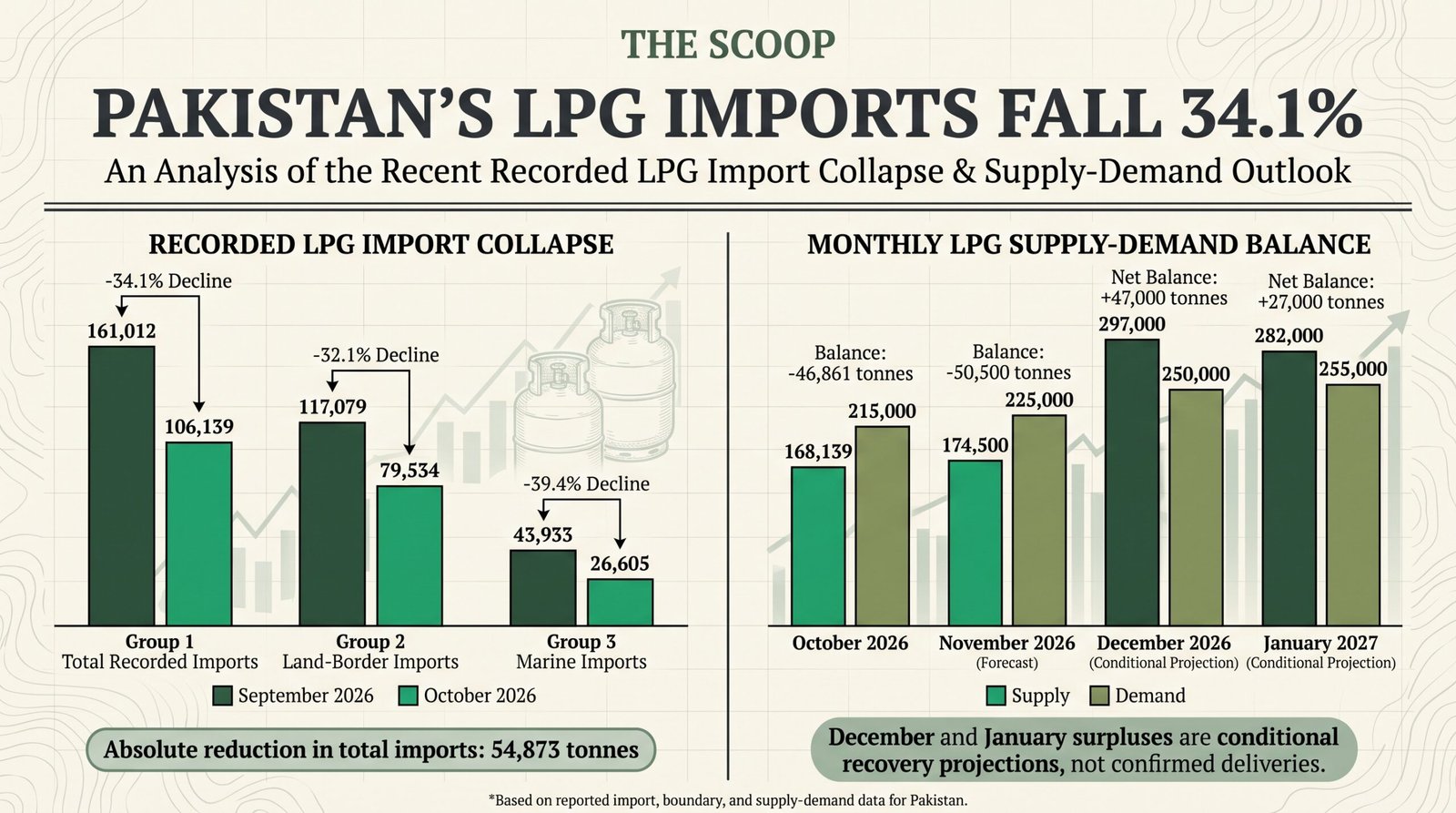
According to Pakistan Customs figures compiled in the October 2026 LPG import assessment, total recorded LPG imports declined from 161,012 tonnes in September to 106,139 tonnes in October.
That represents a reduction of 54,873 tonnes, or 34.1%, in a single month.
Land-border imports declined from 117,079 tonnes to 79,534 tonnes, a fall of 32.1%.
Marine imports also contracted, from 43,933 tonnes to 26,605 tonnes, representing a reduction of 39.4%.
The fall in marine imports is particularly important because alternative seaborne supply should ideally compensate for disruptions affecting land routes.
Instead, both import channels registered significant declines.
The route-wise data reveal further changes.
Recorded LPG clearances through Gabd fell from 104,507 tonnes in September to just 1,582 tonnes in October.
However, clearances through Mand increased from 11,815 tonnes to 60,545 tonnes, while Taftan’s recorded October volume rose to 15,826 tonnes from an unusually low September level of 757 tonnes.
This illustrates an important point: the disruption was accompanied by a substantial redistribution of recorded traffic among border crossings rather than a uniform collapse across every route.
The net effect was nevertheless a serious reduction in total recorded imports.
These are Customs clearance figures and should not be confused automatically with LPG physically consumed during the same month.
An Estimated 46,861-Tonne Supply Gap
The October assessment estimated total LPG availability at approximately 168,139 tonnes, comprising recorded imports of 106,139 tonnes and assumed indigenous production of 62,000 tonnes.
Estimated demand stood at approximately 215,000 tonnes.
On this basis, the apparent supply–demand gap was 46,861 tonnes, equivalent to 21.8% of estimated demand.
The calculation is significant, but its limitations must be clearly understood.
It is an accounting estimate rather than a directly measured national physical shortage.
Actual availability may have differed because of changes in storage inventories, clearance-to-delivery timing, unrecorded movements, informal imports and differences between assumed and actual domestic production.
Nonetheless, a potential imbalance approaching one-fifth of monthly demand helps explain the pressure on market prices.
The assessment also projects a possible November supply gap of approximately 50,500 tonnes, depending on the reliability of its import and demand assumptions.
If those assumptions prove accurate, the shortage pressure could continue even after partial restoration of border movements.
December And January: Recovery Or Another Shortage?
The winter outlook contains both risks and potential relief.
Under one conditional recovery scenario examined in the October import assessment, total LPG supply could increase substantially in December and January if land-border shipments recover and additional marine imports are secured.
The model presents the following supply–demand balances:
| Month | Estimated supply | Estimated demand | Balance |
| October 2026 | 168,139 tonnes | 215,000 tonnes | -46,861 tonnes |
| November 2026 | 174,500 tonnes | 225,000 tonnes | -50,500 tonnes |
| December 2026 | 297,000 tonnes | 250,000 tonnes | +47,000 tonnes |
| January 2027 | 282,000 tonnes | 255,000 tonnes | +27,000 tonnes |
October combines recorded import clearances with assumed indigenous output. November is a forecast, while the December and January surpluses are conditional projections, not confirmed deliveries.
The projected recovery depends on land-border imports increasing sharply and marine imports expanding through state-owned and private companies.
In December, for example, the model assumes 150,000 tonnes through land routes, 85,000 tonnes through marine imports and 62,000 tonnes of indigenous supply.
Such a recovery would be substantial compared with October.
But the projections do not establish that the necessary cargoes have been contracted, financed, shipped or scheduled for delivery.
Under a separate extreme stress scenario in which imports cease completely, the analysis estimates potential December and January deficits of 198,500 tonnes and 205,000 tonnes respectively against higher stress-case demand assumptions.
These figures illustrate vulnerability under an extreme assumption. They should not be presented as a prediction that Pakistan will actually face shortages of that magnitude.
The immediate question is whether the recovery assumed in the more favourable scenario can be physically delivered.
Only Around Ten Days Of Theoretical Storage
Pakistan’s storage limitations represent another major weakness in its energy-security framework.
According to the independent assessment, the country has approximately 70,000 tonnes of installed LPG storage capacity, including only around 14,000 tonnes at seaports.
At annual demand of 2.4 million tonnes, the total capacity represents approximately 10.6 days of average consumption.
If annual demand approaches 3 million tonnes, theoretical storage cover falls to approximately 8.5 days.
These figures assume all storage facilities are filled and their inventories are available where required.
Actual supply security may be weaker because installed capacity is not the same as usable stocks.
Inventory held by private companies, distribution constraints, regional distances and replenishment delays affect how much LPG can reach consumers during an emergency.
The analysts warn that infrastructure must be measured by its ability to maintain deliveries, not simply by the size of installed tanks.
A month-long interruption of the Iranian land routes could expose approximately 108,500 tonnes of normal supply on the government’s official demand baseline, before allowing for alternative cargoes, inventories or changes in consumption.
This is considerably more than Pakistan’s total installed LPG storage capacity.
Port Qasim Cannot Easily Replace Iranian Supply
Diversifying LPG imports requires more than finding new international suppliers.
Pakistan must also possess the terminal infrastructure necessary to receive, store and distribute cargoes.
The independent review identifies significant limitations at Port Qasim, where two principal LPG terminals each have approximately 6,500 tonnes of storage.
These facilities can accommodate vessels of around 10,000 deadweight tonnes, whereas larger vessels used in international LPG trade commonly range from 30,000 to 50,000 tonnes.
Smaller cargoes can increase freight costs and reduce economies of scale.
The absence of refrigerated storage and adequate interconnections further limits operational flexibility.
Even if international suppliers offer additional LPG, Pakistan must ensure that vessels can berth, cargoes can be discharged, storage is available and road bowsers can transport the product inland.
The assessment refers to a proposed infrastructure investment programme of approximately $1 billion, including a 40,000-tonne terminal at Port Qasim.
Such investment could improve long-term resilience, provided it is supported by credible feasibility studies, complementary storage and transport facilities, and fair access for importers.
However, infrastructure projects requiring years to implement cannot solve an immediate winter shortage.
The analysts also recommend examining whether the existing Al-Qasim terminal at Gwadar can be made commercially and operationally useful.
Any such decision would require verified information about the facility’s present condition, licensing, storage, safety standards and inland transportation capacity.
The urgent requirement is an independent terminal-by-terminal assessment of how much additional LPG Pakistan can receive and deliver safely this winter.
Why OGRA’s Pricing Formula Came Under Pressure
Pakistan’s LPG pricing arrangements have struggled to adapt to a market increasingly dependent on imports.
Under the existing framework, OGRA’s monthly price notifications were linked to the Saudi Aramco Contract Price and included a fixed downstream allowance of Rs35,000 per tonne.
According to the independent assessment, this allowance had remained unchanged since 2018, despite significant increases in fuel, transport, foreign-exchange and operating costs.
The analysts estimate that diesel prices increased by approximately 205% and the rupee depreciated by around 155% over the relevant comparison period.
The problem is that Saudi Aramco’s Contract Price is essentially a free-on-board commodity benchmark.
It does not necessarily capture the full cost of delivering LPG to Pakistan, including commercially necessary procurement premiums, shipping, insurance, terminal handling and inland distribution.
Where an official consumer-price ceiling falls below the cost of obtaining additional supplies, importers may have little commercial incentive to bring those supplies into the formal market.
The result can be a regulated price that exists on paper while actual retail transactions take place at substantially higher rates.
The assessment calculates that average filling-plant prices between January and July 2026 exceeded notified prices by approximately Rs60–79 per kilogramme, with the gap reaching Rs158 in March.
The analysts argue that price regulation which cannot support adequate physical supply may inadvertently encourage informal premiums and weaken compliance.
However, they also caution that deregulation is not a substitute for competition.
A genuinely effective pricing framework must recognise efficient import costs without allowing inflated premiums, unnecessary charges or excessive margins to be passed directly to consumers.
Government Launches Major LPG Market Reforms
The federal government has begun implementing significant changes in response to the crisis.
Following earlier policy deliberations, the Cabinet approved a revised LPG framework on 4 November 2026.
The new approach seeks to move towards market-based pricing, transparent auctions of indigenous LPG, greater participation by state-owned companies in imports and targeted assistance for vulnerable households.
The government’s LPG Committee held its first meeting on 7 November under the chairmanship of the Secretary Petroleum.
According to the Petroleum Division, 10% of indigenous LPG production will be allocated to state-owned marketing companies to serve remote and difficult areas.
The remaining 90% will be offered through transparent auctions.
The committee also decided that each participating company would be allowed a maximum daily allocation of 20 metric tonnes.
The stated objective is to reduce preferential allocations, widen participation and ensure a more equitable distribution system.
These measures represent an important acknowledgement of longstanding weaknesses in the LPG market.
Petroleum Minister Ali Pervaiz Malik has presented the reforms as an attempt to improve affordability, competition, supply-chain resilience and consumer protection.
The critical issue is implementation.
Auction rules must address the number of genuinely independent bidders, beneficial ownership, related-party participation, available quantities and the possibility of unallocated supply.
The government must also clarify how the new market framework will operate alongside OGRA’s statutory responsibilities.
A Cabinet policy decision, an auction arrangement and a legally effective change in price regulation are not necessarily the same thing.
Transparency over the applicable legal instruments and transition arrangements is therefore essential.
Four State-Owned Companies Directed To Enter Imports
The revised policy also envisages increased public-sector participation in international LPG procurement.
Four entities have been identified for import-related roles: Pakistan State Oil, Pakistan LNG Limited, SSGC LPG Limited and PARCO Pearl Gas.
The government’s stated objective is to create additional procurement channels through commercial and government-to-government arrangements while reducing vulnerability to disruptions affecting Iranian imports.
State-owned companies can perform a useful supply-security function, particularly when emergency cargoes are required.
However, their participation must be measured by whether it increases the quantity of LPG available nationally at reasonable costs.
According to the independent assessment, PSO Pak Gas and SSGC LPG Limited together account for only approximately 5.4% of the domestic LPG market.
The analysts question whether all designated public-sector entities possess sufficient specialised experience in direct international LPG procurement, shipping and terminal logistics.
They also warn against preferential treatment that could weaken the commercial position of existing private importers.
An Unverified Procurement Allegation
The assessment refers to an industry allegation involving a proposed LPG cargo reportedly negotiated by a private importer with a Dubai-based supplier.
According to that account, the supplier allegedly withdrew after receiving a competing offer from PSO involving a premium said to exceed $100 per tonne.
The allegation remains unverified.
The Scoop has not independently established that the transaction occurred as described, nor has it examined the relevant contracts, bids or supplier correspondence. No finding of wrongdoing or improper procurement by PSO can be drawn from the material currently available.
Nevertheless, the issue illustrates why transparent procurement benchmarks and independent cost verification are important when state-owned purchase prices may influence domestic market prices.
Public procurement should demonstrably add physical supply rather than merely redistribute existing cargoes at a higher price.
Iran Conflict Creates A Second Supply-Security Threat
Pakistan’s concentration of LPG imports through Iran also exposes the country to geopolitical risks beyond domestic border-management decisions.
The continuing Iran–US conflict, sanctions restrictions and disruption affecting Gulf maritime trade have complicated energy supply chains across the region.
On 7 November, US Central Command announced the establishment of Task Force Iron Gate, intended to strengthen American efforts against the movement of weapons, sanctioned materials and illicit revenue through Iranian land routes and the Caspian region.
This development adds another source of uncertainty for commercial transactions involving Iran.
It does not, by itself, establish that every lawful LPG shipment across the Pakistan–Iran border has been prohibited.
However, the wider sanctions and security environment may complicate procurement, payment arrangements, transportation and commercial risk assessments.
The independent assessment estimates that the normal Iranian land-route LPG trade represents a commodity flow worth roughly $1 billion annually at prevailing benchmark prices.
The economic significance of that exposure reinforces the need to diversify suppliers, transportation routes and payment arrangements.
Multiple border crossings do not necessarily provide genuine diversification when they depend on the same source country and face correlated political and security risks.
Pakistan’s LPG Crisis Is Also An LNG Crisis
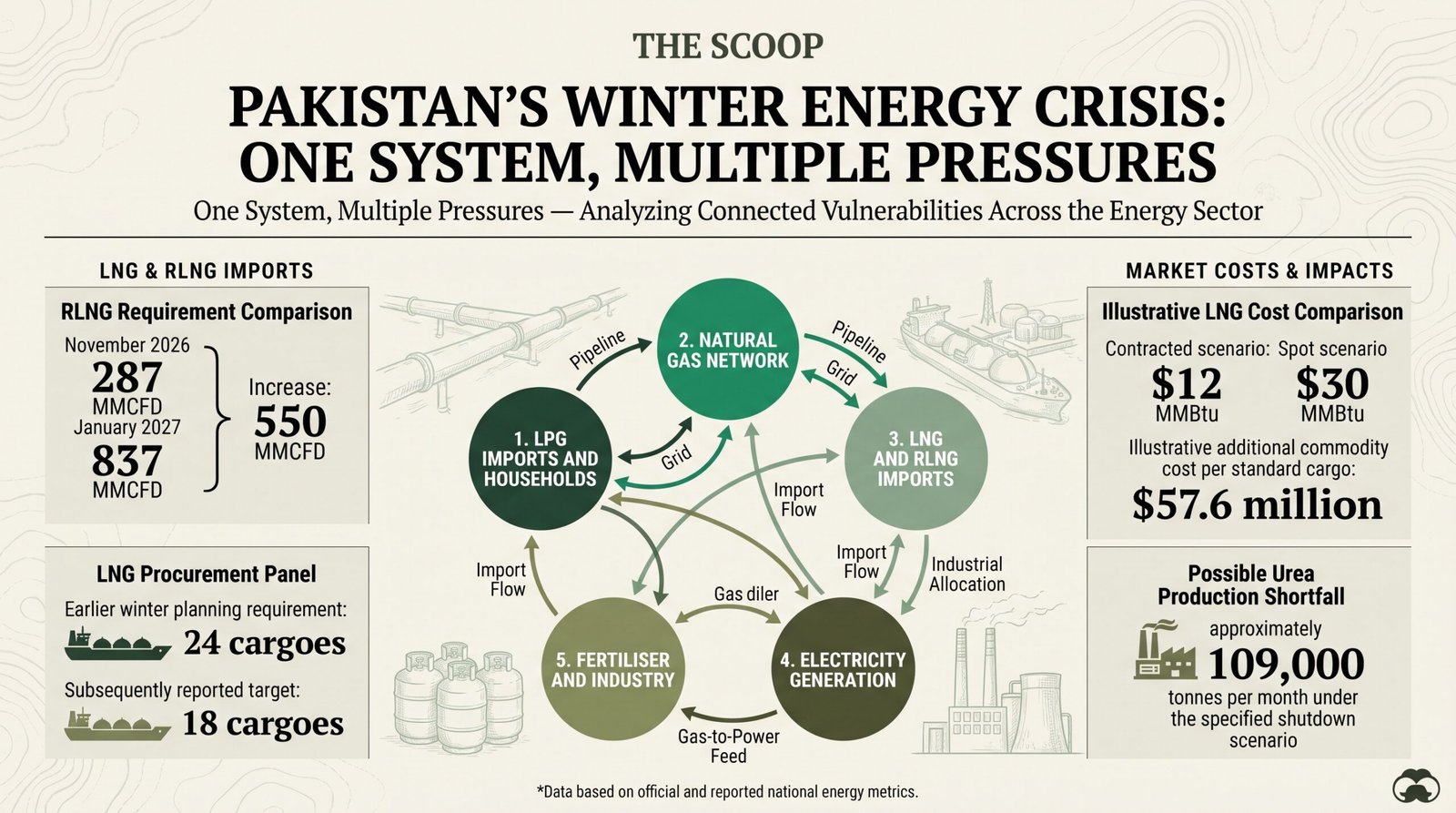
The most consequential finding emerging from the attached energy assessments is that LPG shortages cannot be viewed separately from Pakistan’s wider natural gas and electricity systems.
During winter, households increase consumption of natural gas for space heating, water heating and cooking.
When piped gas becomes unavailable or unaffordable, some consumers move to LPG, electricity or other fuels.
This additional demand can place pressure on an LPG market already facing import constraints.
In a separate analysis titled The Winter Constraint: Integrated Planning for LNG, Power and LPG, Asim Riaz writes:
“Winter energy security therefore cannot be managed through separate gas, LNG, LPG and power plans.”
His argument highlights the danger of managing individual fuels through separate administrative and procurement decisions when their costs and consumption patterns are closely connected.
Government winter planning estimates examined in the assessment show that the SNGPL-linked system’s requirements, including specified supplies for SSGC and K-Electric, could increase from approximately 1,062 million cubic feet per day in November to 1,612 MMCFD in January.
Indigenous gas availability within that particular planning balance remains approximately 775 MMCFD.
The corresponding requirement for regasified LNG therefore increases from 287 MMCFD in November to approximately 837 MMCFD in January.
That represents an increase of 550 MMCFD in the required RLNG component over just two months.
The challenge is not necessarily a permanent annual shortage of LNG. It is ensuring that sufficient gas is physically deliverable during the short period when demand reaches its winter peak.
The 24-Cargo Plan And The Revised 18-Cargo Target
An earlier Petroleum Division winter assessment identified a planning requirement of 24 LNG cargoes between November 2026 and February 2027.
Of these, nine were intended for power generation and 15 for domestic requirements, including two contingency cargoes.
Subsequent reporting on 21 October indicated that the government had reduced its intended winter procurement target to 18 cargoes.
The two figures therefore represent different stages of winter planning and should not be presented as simultaneous confirmed procurement commitments.
The final approved cargo programme, actual contractual nominations and the latest delivery status remain essential matters for official clarification.
The government has also pursued alternative procurement arrangements amid uncertainty surrounding contracted LNG supplies from Qatar.
On 4 November, Pakistan LNG Limited invited bids for two spot LNG cargoes, with delivery windows in December 2026 and January 2027.
Issuing a tender does not establish that cargoes have been awarded, loaded or delivered.
The distinction between planned cargoes, commercially committed cargoes and physically delivered cargoes is central to winter energy security.
As Riaz observes in his separate winter analysis:
“A cargo appearing in a winter planning balance is not necessarily a cargo that will physically arrive.”
Expensive Spot LNG Could Transfer Costs To Consumers
Disruptions to contracted LNG supplies also present a substantial financial risk.
The winter assessment uses an illustrative contracted LNG price of $12 per million British thermal units, compared with spot-market scenarios of approximately $27–30 per MMBtu.
For a standard cargo assumed to contain 3.2 million MMBtu, the commodity cost would be approximately $38.4 million at $12 per MMBtu.
At $30 per MMBtu, the same cargo would cost approximately $96 million.
That represents an illustrative difference of $57.6 million for one cargo.
Replacing five such cargoes at the higher price would imply an additional commodity cost of approximately $288 million compared with the assumed $12 benchmark.
These calculations are scenarios, not verified costs of actual government purchases. Real exposure would depend on contractual prices, cargo specifications, shipping, exchange rates, regasification charges and the availability of alternative supplies.
Nevertheless, the implications are substantial.
Higher LNG procurement costs could affect gas tariffs, electricity generation costs, fiscal support requirements and the financial position of state-owned energy companies.
A winter procurement strategy therefore needs to optimise both physical availability and total economic cost.
Gas Diversion Can Shift The Burden To Electricity
The allocation of limited RLNG supplies creates difficult policy trade-offs.
Providing greater quantities of relatively cheaper contracted gas to domestic consumers may protect households from shortages.
However, diverting those supplies away from power generation can increase reliance on alternative fuels or more expensive electricity generation.
If power plants must replace contracted LNG with expensive spot supplies or liquid fuels, the cost does not disappear.
Instead, it may emerge in electricity tariffs, power purchase costs, fiscal subsidies or circular debt.
The situation becomes more complicated during winter when hydropower generation can decline and regional transmission limitations affect the ability to move lower-cost electricity to areas experiencing high demand.
The assessment argues that fuel allocation must therefore consider the economic and social consequences across the entire energy system.
It would be misleading to treat a reduction in gas-sector costs as an overall saving if the same decision substantially raises electricity-sector expenditure.
Fertiliser And Industrial Production Face Winter Risks
Pakistan’s winter gas-management proposals also carry implications for fertiliser production, industrial output and employment.
Government planning documents have contemplated prioritising residential consumers during severe shortages, with industry, captive power, CNG and some fertiliser production potentially facing curtailment.
The winter assessment examines a scenario involving three fertiliser plants: Fauji Fertilizer Bin Qasim, Fatima Fertilizer and Agritech.
Under the specified shutdown scenario, the assessment identifies a possible urea production shortfall of approximately 109,000 tonnes per month.
Such a disruption could affect fertiliser inventories and create additional import requirements.
The attached presentation compares indicative costs for supplying 75,000 tonnes of urea under different scenarios, with imported urea estimated at Rs5.32 billion, domestic production using industrial RLNG at Rs7.63 billion and domestic production using substantially more expensive spot LNG at Rs13.81 billion.
These are scenario-based estimates rather than verified actual production or procurement costs.
Their significance lies in the need to evaluate whether scarce winter gas should be allocated to a particular industrial activity or whether its output could be obtained at a lower overall economic cost through alternatives.
A poorly coordinated allocation policy could protect one group of consumers while generating higher costs elsewhere.
Also Read: Punjab’s Fiscal Management: Laws Without Accountability
How Piped Gas Shortages Could Increase LPG Demand
The interaction between LPG and natural gas is another major concern.
The independent assessment calculates that, on an energy-equivalent basis, replacing 1 MMCFD of natural gas would require approximately 22 tonnes of LPG per day.
A hypothetical diversion of 50 MMCFD of piped-gas demand entirely towards LPG would therefore require approximately 1,100 additional tonnes daily.
This is not a forecast of actual consumer switching.
Households may reduce consumption, use alternative appliances or be unable to afford equivalent LPG supplies.
Nevertheless, the calculation demonstrates the scale of additional demand that could arise if shortages of piped gas become severe.
The analysis also estimates that the energy contained in one standard LNG cargo is roughly equivalent to 65,000–75,000 tonnes of LPG.
The fuels cannot simply be substituted on a one-for-one operational basis, but the comparison demonstrates how relatively small changes in gas consumption can become significant in an already constrained LPG market.
This is particularly important for households outside the piped-gas network, which face greater exposure to expensive cylinder fuel.
Why Pakistan’s Winter Heating Demand Needs Reform
A substantial portion of Pakistan’s winter gas requirement relates to heating rather than cooking.
The attached energy analysis draws on end-use studies indicating that close to three-fifths of residential natural gas consumption in January is associated with space and water heating.
Cooking demand is essential and generally less flexible.
Heating demand, however, may be reduced through efficient appliances, improved building insulation, solar water heating and carefully designed electrification programmes.
This does not mean all households can immediately replace gas heaters or geysers with electric alternatives.
Electricity tariffs, appliance costs, grid capacity, local distribution constraints and seasonal electricity generation must all be considered.
Unplanned electrification could increase demand for expensive thermal power.
A gradual, targeted transition could, however, make better use of electricity generation capacity that is underutilised during winter.
The strategic objective should be to provide affordable heating and hot water at the lowest sustainable system cost rather than assume that every additional winter requirement must be met by imported gas.
LPG Market Has Hundreds Of Licensees, But Safety Remains Weak
The independent assessment estimates that Pakistan has approximately 464 licensed LPG marketing companies.
No single operator reportedly accounts for more than about 9% of national sales.
At first glance, this may suggest a competitive market.
However, the number of licences does not necessarily indicate effective competition, infrastructure investment or compliance with safety regulations.
The analysts compare Pakistan’s fragmented market with India and Bangladesh, where fewer major suppliers or active importers operate alongside substantial storage, bottling and distribution infrastructure.
The comparison raises questions about whether Pakistan’s licensing framework adequately links commercial participation to technical expertise, investment capability and regulatory compliance.
The safety implications are substantial.
According to figures cited in the assessment from parliamentary proceedings, an estimated 2,000 LPG bowsers were operating nationally, of which approximately 800 were registered with the Department of Explosives and 247 licensed by OGRA.
The analysis also refers to a separate estimate of around 2,600 bowsers, indicating that national fleet figures require reconciliation.
Around five million LPG cylinders are reportedly in circulation.
Unsafe decanting, cross-filling of branded cylinders, substandard equipment and weak enforcement have contributed to repeated accidents.
The report states that LPG-related explosions have claimed hundreds of lives over the past five years, although a fully reconciled national fatality database is not supplied.
A particularly important issue is the proposal to defer certain land-border quality-testing and bowser-compliance requirements until 30 June 2027.
While immediate blanket enforcement could disrupt already strained LPG transportation, postponing essential safety measures may expose consumers and transport workers to avoidable risks.
A risk-based transition should distinguish paperwork deficiencies from serious mechanical and pressure-vessel defects.
Price liberalisation and safety enforcement must proceed together.
What Happens To Indigenous LPG Producers?
Domestic LPG production presents another policy challenge.
Pakistan’s indigenous LPG is obtained primarily from natural gas processing and refinery operations.
These sources have different production costs from imported LPG.
Where domestic LPG is sold at an import-parity price above its economically necessary production cost, producers may earn additional margins.
Such margins are often described as economic rents.
The revised policy framework seeks to change how indigenous LPG is allocated and how the difference between producer remuneration and market-linked benchmarks is distributed.
However, the analysts caution that revenue collection must not undermine incentives to recover additional LPG from gas fields and processing facilities.
Enhanced recovery from wet gas, associated gas and other commercially viable sources could reduce long-term import dependence.
The appropriate financial arrangements may vary among exploration and production companies, gas-processing facilities and refineries.
A uniform approach could unintentionally discourage investments that would otherwise increase domestic supply.
The government therefore needs project-specific economic analysis, transparent producer payments and a mechanism that encourages efficient incremental recovery.
Can The New LPG Subsidy Protect Poor Households?
The government’s proposed consumer-protection framework includes assistance for economically vulnerable households.
Petroleum Minister Ali Pervaiz Malik has indicated that the government wants eligible consumers to receive LPG at approximately Rs300–350 per kilogramme through a support mechanism linked to the Benazir Income Support Programme.
The proposed Producer-Price Differential Fund is intended to help finance such assistance through pricing differentials associated with indigenous LPG.
The initiative addresses an important inequality.
Households with access to piped natural gas can benefit from administered tariff arrangements, while millions of households outside the network rely on more expensive alternative fuels.
The independent assessment states that more than 25 million households depend on fuels other than piped gas, compared with just over 10 million connected to the gas network.
It also argues that domestic LPG can cost more than 20 times as much as piped natural gas under some tariff comparisons, although the precise ratio depends on consumer category, tariff and fuel-energy assumptions.
A targeted subsidy could provide meaningful relief.
But its success will depend on identifying genuine beneficiaries, ensuring adequate physical supply and preventing abuse.
The analysts recommend using the National Socio-Economic Registry, which contains information on approximately 35 million households, alongside verifiable eligibility rules and traceable transactions.
A hypothetical Proxy Means Test threshold discussed in the report is illustrative only and should not be confused with an officially approved LPG eligibility criterion.
The fund’s legal basis, administration, financing, auditing and relationship with existing BISP resources must also be publicly clarified.
A subsidy cannot protect a household if affordable LPG is not physically available through an authorised supplier.
Demand Could Reach 4.16 Million Tonnes By 2033
Pakistan’s LPG problem is unlikely to disappear after the present winter.
Government projections cited by the analysts suggest that annual LPG demand could rise from approximately 2.4 million tonnes in FY2025–26 to 4.16 million tonnes by FY2032–33.
Domestic production is projected at approximately 1.35 million tonnes by that time.
This would leave an import requirement of roughly 2.8 million tonnes annually.
Without corresponding investment in storage, marine terminals, inland logistics and indigenous production, the country could become increasingly vulnerable to international price volatility and supply disruptions.
Existing installed storage of 70,000 tonnes would represent only about six days of theoretical consumption at the projected future demand level.
This raises the prospect of a structural supply-security problem becoming more pronounced over time.
The choice is therefore not simply between importing more LPG and reducing present shortages.
Pakistan must determine how its energy infrastructure, commercial procurement arrangements and household fuel policies should evolve over the coming decade.
Who Should Be Held Accountable?
The evidence raises serious questions for the Petroleum Division, OGRA, Ministry of Commerce, Customs authorities, state-owned energy companies and other institutions responsible for fuel supply.
When did the government formally recognise that disruptions along the Taftan corridor could continue into winter?
What replacement cargoes were considered during June, July, August and September?
Were international suppliers approached, and were commercially viable offers received?
Why did marine LPG imports fall during October instead of expanding to compensate for the interruption of land-border routes?
How much usable LPG inventory was available nationally when the crossings closed?
What additional volumes can Port Qasim and other existing terminals physically deliver before January?
Which of the projected December and January LPG cargoes have been contracted, financed, scheduled and confirmed?
What is the final approved winter LNG cargo target, and how does it compare with the earlier 24-cargo requirement and subsequently reported 18-cargo target?
How much RLNG will be diverted towards residential consumption, and what will be the resulting cost for electricity generation, industry and gas utilities?
How will the government ensure that state-owned LPG procurement increases supply rather than displacing existing private imports?
Who will independently verify landed costs used as pricing benchmarks?
And what arrangements will ensure that LPG support reaches low-income households without undermining supply, competition or essential safety standards?
The authorities should publish sufficiently detailed supply, procurement and inventory information to enable independent scrutiny while protecting legitimate commercial and security-sensitive details.
The Government’s Reform Initiative Deserves Recognition — But Results Will Matter
The federal government’s move towards competitive indigenous LPG auctions, more diversified procurement channels and targeted assistance for vulnerable consumers represents an important policy response.
The involvement of Petroleum Minister Ali Pervaiz Malik, the Cabinet’s approval of the revised framework and the formation of the implementation committee demonstrate official recognition that existing arrangements require substantial change.
The reforms could improve market access and supply resilience if they are implemented transparently and supported by independent oversight.
However, their effectiveness must be judged through measurable outcomes rather than policy announcements.
A successful framework should increase reliable physical supply, attract sustainable infrastructure investment, strengthen domestic LPG recovery, improve consumer safety, establish credible price discovery and ensure that assistance reaches vulnerable households.
The government must also preserve the independence and statutory responsibilities of OGRA while ensuring that the Competition Commission of Pakistan and relevant safety authorities can enforce their respective mandates.
Regulatory change should not replace one form of market distortion with another.
Riaz And Sheikh Call For Integrated Energy Planning
The central conclusion of the assessments prepared by Asim Riaz and Dr Imran Nasir Sheikh is that Pakistan requires a coordinated national energy-security framework rather than separate responses to LPG, LNG, natural gas and electricity shortages.
Their joint analysis identifies the need for reliable supply data, diversified procurement, stronger infrastructure, independently verified costs, targeted consumer protection and institutional accountability.
Riaz’s separate winter analysis reinforces the importance of coordinating fuel planning with electricity demand, seasonal heating requirements, transmission capability and actual LNG deliveries.
The policy challenge is particularly urgent because shortages in one fuel can increase demand and costs in another.
LPG scarcity can affect cooking and household welfare. LNG disruptions can threaten electricity generation and industrial supply. Natural gas curtailment can increase LPG demand. Expensive replacement fuels can move costs into tariffs or public finances.
These problems are interconnected.
Pakistan therefore requires a winter fuel plan that reflects physical cargo availability, operational infrastructure, credible seasonal demand and realistic alternatives.
Conclusion: Pakistan Cannot Afford Another Winter Of Reactive Energy Management
Pakistan’s LPG crisis demonstrates how external disruptions can expose longstanding domestic weaknesses.
The 17 October border closures were an immediate trigger, but the vulnerabilities predated the disruption.
Dependence on Iranian imports was already substantial. Security incidents had affected tanker movements for months. Storage capacity remained limited. Marine infrastructure could not automatically substitute for disrupted land routes. Regulatory pricing arrangements were increasingly disconnected from market conditions.
At the same time, winter LNG uncertainties and competing demands from households, electricity generation, fertiliser and industry have complicated the broader energy balance.
The government’s recent reform initiative provides an opportunity to address these problems.
But successful implementation requires more than revised regulations, additional state-owned procurement and promises of affordability.
It requires timely cargo contracting, verifiable inventories, functioning infrastructure, commercially credible prices, stronger safety enforcement, fair competition and accountability for supply outcomes.
For millions of Pakistani households facing historically high LPG prices, the test will be whether cylinders become reliably available at prices they can afford.
For policymakers, the larger test is whether Pakistan emerges from the winter of 2026–27 with a stronger and more resilient energy system.
The warning signs were visible.
The question now is whether the country will act on them before another foreseeable disruption becomes a national crisis.