

When I wrote about the death of Maggi noodles in Pakistan in January 2020, the story was about the disappearance of one of the country’s most recognisable consumer brands.
Maggi entered Pakistan in 1992. Knorr followed a year later. Shan’s Shoop arrived in 2012. By the time Maggi was discontinued, the market had evolved into a three-player contest, with Knorr already leading and Shoop attempting to establish itself as the domestic challenger.
Six years later, however, the more interesting story is not the death of Maggi. It is what happened after it died.
Pakistan’s instant-noodles market has grown. More brands have entered. Imported Korean and Indonesian noodles have become increasingly visible. Local manufacturers have introduced new flavours and formats. Shoop has expanded into Korean-style noodles, Indomie is now manufactured in Pakistan, and retailers carry products from Nissin, Samyang, Kai, Mi ABC and several other brands.
Yet none has managed to build a publicly documented nationwide market share remotely comparable with Knorr.
In fact, if Unilever Pakistan’s own current figure is taken as a reference, Knorr has gone from being the market leader to an extraordinary 95% share of Pakistan’s instant-noodles market.
That is a company-reported figure, not an independently audited October 2026 market-share estimate, and it should therefore be treated accordingly. But it is not an isolated claim. The same 95% figure was reported by Aurora in 2022, when it described Kolson, Shan and imported brands such as Samyang as collectively accounting for less than 5%.
The paradox is remarkable:
Maggi disappeared, the category expanded, dozens of products appeared — and Knorr became even more difficult to dislodge.
The market Maggi left behind
In my original 2020 story, Nielsen data put Knorr at roughly 55% of Pakistan’s instant-noodles market, Maggi at around 35% in its final period and Shoop at approximately 10%. That created an obvious commercial opportunity. If a 35% player disappeared, surely somebody would inherit that business. But consumer markets do not always work that way.
The disappearance of a brand does not mean its market share is automatically divided equally among competitors. Consumers have to be persuaded to change brands, retailers have to stock alternatives, distributors have to carry them, manufacturers need enough production capacity and the new brand has to establish repeat purchasing.
Knorr already had all of those advantages. It had been in Pakistan since 1993, giving it more than three decades to build consumer familiarity and distribution. Unilever says Knorr’s flavours were developed to suit local tastes, with Chatpatta and Chicken becoming longstanding favourites.
So when Maggi disappeared, Knorr was not starting from zero. It was already sitting on the shelf.
The market itself has become larger
The category has also changed considerably. Euromonitor’s Pakistan research shows that instant noodles have benefited from changing lifestyles, urbanisation and demand for convenient food. Its latest November 2025 report covers company and brand shares through 2025 and identifies convenience, urban lifestyles and changing consumer preferences as important drivers of packaged-food demand.
Euromonitor’s 2024 Pakistan report similarly described instant noodles as a growing snack and quick-meal category, with new products including Shan’s Korean-style noodles entering the market.
That is important. The failure of challengers cannot simply be explained by saying that there was no market. There is a market. And it has become considerably more sophisticated.
More brands, but not necessarily more competition
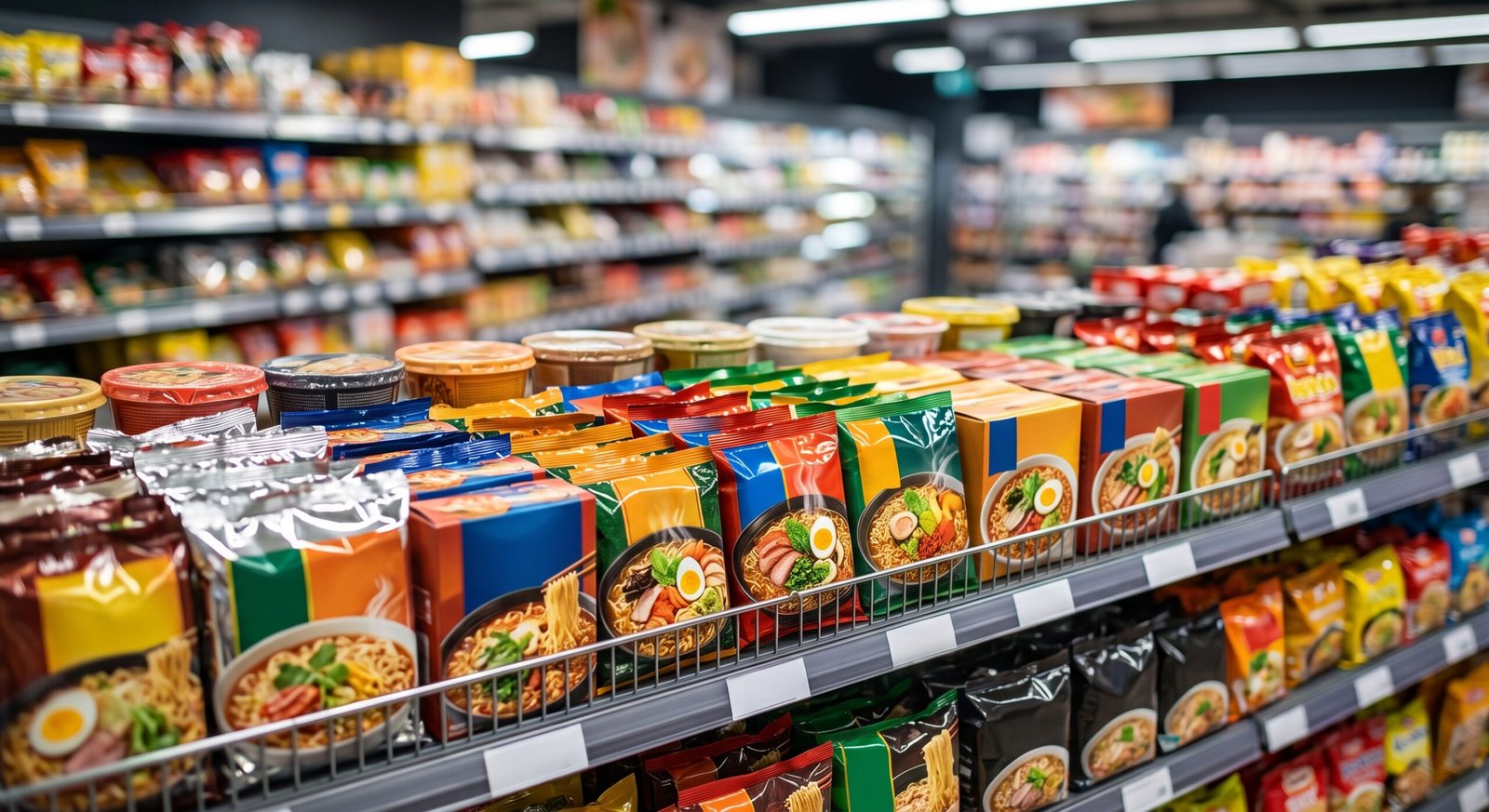
Walk into a major supermarket in Lahore, Karachi or Islamabad today and the difference from 2020 is immediately visible.
- There are mainstream local products such as Knorr, Shoop and Noodle Doodle.
- There is Indomie, which now says it is manufactured in Pakistan and offers Lemon Tarka, Meat Masala and Chicken variants.
- There are Korean products such as Samyang and Kai.
- There are Nissin products.
- There are premium and imported varieties aimed at consumers who are willing to pay substantially more for different flavours and formats.
Al-Fatah’s current online catalogue, for example, lists Knorr, Indomie, Nissin, Kai, Koka, Kolson, Shan and other noodle brands. Carrefour Pakistan’s current catalogue similarly shows Knorr, Indomie, Shoop, Samyang and Korean-style products competing on the same broad shelf. But shelf diversity is not the same thing as market-share diversity. That distinction is the key to understanding the Pakistani noodles market.
Shoop survived — but did not become Maggi
Shan’s Shoop was the obvious candidate to inherit Maggi’s customers. The brand was already established when Maggi left. Shan had a large domestic distribution network, a strong food brand and substantial experience in Pakistani tastes. Yet Shoop never became the dominant replacement. It remains a meaningful brand and continues to innovate. Shan now sells conventional Shoop flavours as well as a dedicated Korean Noodles range, including Chilli Blast, Cheese and Carbonara. The current retail shelf confirms that Shoop remains firmly present in the mainstream segment. Carrefour lists its Chicken, Chatpatta, Spicy Chicken and Korean products, while other retailers carry multiple Shoop formats. But presence is not dominance. The brand has managed to remain relevant without becoming the national market leader.
Kolson tried too
Lotte Kolson’s Noodle Doodle was another attempt to break the established order. The brand entered the market with packet and cup formats and targeted younger consumers. A marketing executive involved in the launch said Noodle Doodle reached about 4% market share in its first year. That demonstrated that an entrant could gain a foothold. But it also demonstrated the difference between entering a market and changing its structure. Noodle Doodle remains available, but it has not emerged as a national challenger capable of seriously altering Knorr’s position. The problem is not necessarily the product. It is scale.
Then came the Asian noodle boom
The biggest change since 2020 may actually be the arrival of a completely different kind of competitor. Korean noodles have exploded in visibility among Pakistani consumers, particularly younger urban consumers. Samyang’s Buldak range has become a recognisable premium product. Nissin, Kai and other Asian brands have also established retail presence. Shan itself has responded by launching Korean-style Shoop noodles. Even Knorr has entered the premium/ramen space. But these products are not necessarily competing with the traditional 50g packet of Knorr on the same economic basis. Current Carrefour listings illustrate the difference. A 50g Knorr packet is listed at Rs50, while 140g Samyang Buldak is Rs550. Shoop’s standard 65g packets are around Rs45, while its Korean 140g variants are around Rs300. Indomie 70g products are around Rs65. The premium market can therefore grow without destroying the mass-market incumbent. A consumer buying a Rs550 packet of Buldak is making a very different purchasing decision from a student buying a Rs50 packet of Knorr. The products occupy the same broad category. They do not necessarily occupy the same market.
Indomie presents a different challenge
Indomie is particularly interesting because, unlike many imported brands, it now says it is manufactured in Pakistan. The Indonesian brand has global scale and is already distributed across Asia, Africa, the Middle East, Europe and North America. Its Pakistani operation currently markets localised flavours including Lemon Tarka, Meat Masala and Chicken. That gives Indomie an advantage over a purely imported premium product. It can potentially compete closer to the mainstream price point. But having manufacturing capacity does not automatically translate into market share. The brand still has to persuade millions of consumers who have grown up with Knorr to change their habitual purchase. That is much harder.
The economics of a Rs50 packet
This is where the Pakistani noodles market becomes particularly interesting. Instant noodles are a low-ticket, high-volume consumer product. A manufacturer does not make money merely by producing a good noodle. It needs enormous distribution. It needs the product to be available not only at Carrefour and Al-Fatah but at the neighbourhood grocery store, the corner shop, the school canteen, the university tuck shop and thousands of small retailers across the country.
That requires:
Manufacturing + distribution + retailer margins + shelf space + marketing + promotions + repeat purchases.
The noodle itself may be relatively easy to replicate. The ecosystem around the noodle is not.This is one reason a company can launch a perfectly respectable product and still fail to acquire meaningful national share.
Knorr has something new entrants cannot buy overnight
Knorr’s biggest competitive advantage may therefore not be its recipe. It is time.
- Three decades of consumer familiarity matter.
- Three decades of retailer relationships matter.
- Three decades of distribution matter.
And three decades of consumers associating a particular flavour profile with what an instant noodle is supposed to taste like matter. Unilever has also continued investing in the brand.
Its 2025 annual report says Knorr Noodles was the company’s leading growth driver during the year. The company refreshed its core range, introduced updated packaging and anime-inspired communication, adopted a more social-media-led strategy and launched Spicy Beef. It said these initiatives improved brand salience and market share.
The company’s financial results underline the scale of the business behind the brand. Unilever Pakistan Foods reported Rs40.57 billion in sales in 2025, up 20.4% from Rs33.71 billion in 2024. Profit after tax stood at Rs5.95 billion. The company specifically identified Knorr Noodles as the leading growth driver. For the first nine months of 2025, sales were already up 21.3% year-on-year to Rs30.08 billion, with the company again identifying Knorr Noodles as the leading growth driver. These figures cover Unilever Pakistan Foods’ entire portfolio, not noodles alone. But they demonstrate the financial scale and marketing resources behind the company that owns Pakistan’s dominant noodles brand.
The biggest change: noodles are no longer just for children
There is another lesson hidden inside the market. For years, instant noodles were marketed primarily as a children’s product. That has changed. Unilever’s own reporting says Knorr has been repositioned from a children’s product towards teenagers and Gen Z, with digital trends, anime-inspired communication and social-first marketing becoming increasingly important. The company says Gen Z represents 40% of Pakistan’s population.
This is commercially important.
- A teenager eating noodles after school is one consumption occasion.
- A university student eating noodles late at night is another.
- A young professional looking for a quick meal is another.
- A family buying a larger pack is another.
The market has therefore moved from a narrow children’s-snack proposition towards a broader convenience-food category. That helps explain why the market can grow while the dominant brand remains dominant.
New entrants are finding niches rather than taking the mass market
The current market appears to be splitting into several layers. At the bottom is the affordable mainstream packet. That is where Knorr and Shoop compete most directly. Then there is a middle tier, including products such as Indomie and other locally available brands. Above that is the premium and imported segment, where Samyang, Nissin, Kai and other Asian products compete. There is also a growing cup-noodle and convenience segment. Retail listings show this increasing variety clearly. Carrefour currently carries Knorr, Kolson, Kai and Yopokki across its cup-noodle category, while Al-Fatah lists Nissin, Kai, Indomie, Koka, Kolson, Shan and others. The result is a market with more products but not necessarily more national-scale competitors. That is a subtle but important distinction.
What happened to Maggi?
Looking back, the 2020 story can now be read differently. Maggi’s disappearance certainly created an opportunity. But an opportunity is not the same thing as an automatic transfer of market share. The customers who once bought Maggi did not suddenly divide themselves equally between Shoop, Noodle Doodle and imported noodles. Many simply moved to the most familiar alternative. That alternative was Knorr.
And once Knorr absorbed a larger customer base, the increased scale strengthened the very advantages that challengers were trying to overcome.
- More distribution.
- More visibility.
- More marketing.
- More consumer familiarity.
- More flavours.
- More data about what Pakistani consumers want.
The winner of the Maggi exit was therefore not necessarily the company that captured the largest number of former Maggi consumers in one dramatic move.
It was the company already positioned to absorb them.
The strange lesson of the Pakistani noodles market
Six years after Maggi disappeared, Pakistan has more instant-noodle brands than ever.
- There are local brands.
- There are international brands.
- There are Korean noodles.
- There are premium noodles.
- There are cup noodles.
- There are spicy noodles.
- There are noodles aimed at Gen Z.
- There are noodles manufactured locally and noodles imported from Asia.
Yet the mass market remains remarkably concentrated.
Unilever currently claims that Knorr has 95% of Pakistan’s instant-noodles market. The figure should not be treated as an independently verified October 2026 market-share statistic, but the same 95% share was publicly reported in 2022, while current retail shelves show a much wider range of challengers than existed when Maggi disappeared.
That combination tells the real story. Competition has increased at the shelf level. It has not necessarily increased at the mass-market level. The new entrants have created niches, premium segments and alternatives.
But nobody has yet demonstrated the ability to replicate Knorr’s combination of price, distribution, localisation, brand recognition and decades of consumer habit.
And that is perhaps the biggest lesson from the death of Maggi.
Maggi left Pakistan. The noodles market did not die with it.
- It grew.
- New brands came.
- Consumers experimented.
- The shelves became crowded.
- But the space Maggi left behind was not conquered by a new challenger.
- For now, it has largely strengthened the incumbent that was already there.
- The question for the next six years is therefore not whether Pakistanis will eat more noodles.
- The evidence suggests they will.
- The more interesting question is whether any challenger can finally turn Pakistan’s growing appetite for instant noodles into enough scale to seriously dent Knorr’s extraordinary lead.