

ISLAMABAD, November 6, 2026: Pakistan’s federal capital is undergoing an ambitious development drive as Interior Minister Syed Mohsin Raza Naqvi advances a series of infrastructure, tourism, hospitality, entertainment and commercial projects aimed at transforming Islamabad from a predominantly administrative city into a more diversified economic centre capable of attracting foreign investment, generating employment and stimulating business activity.
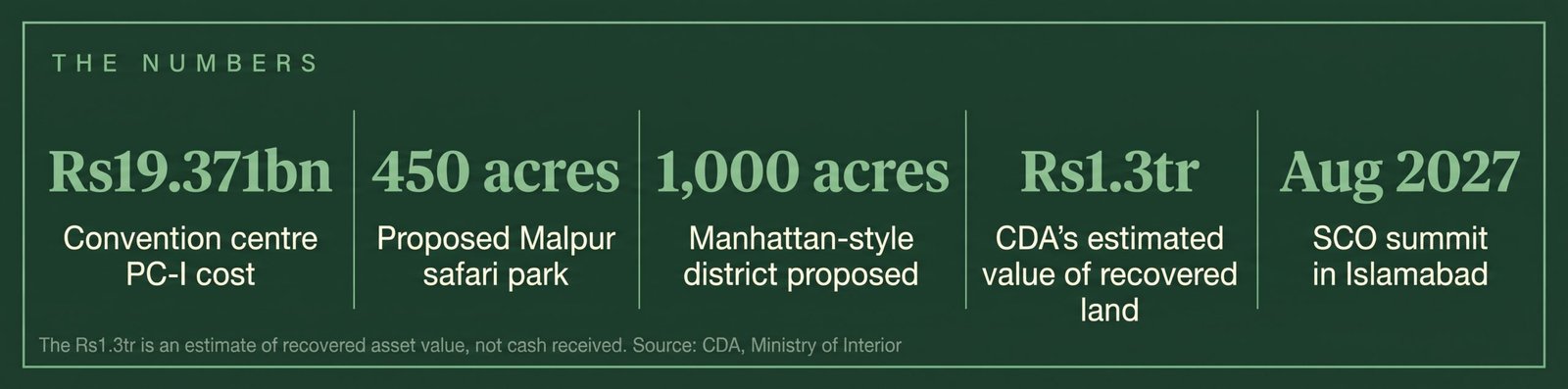
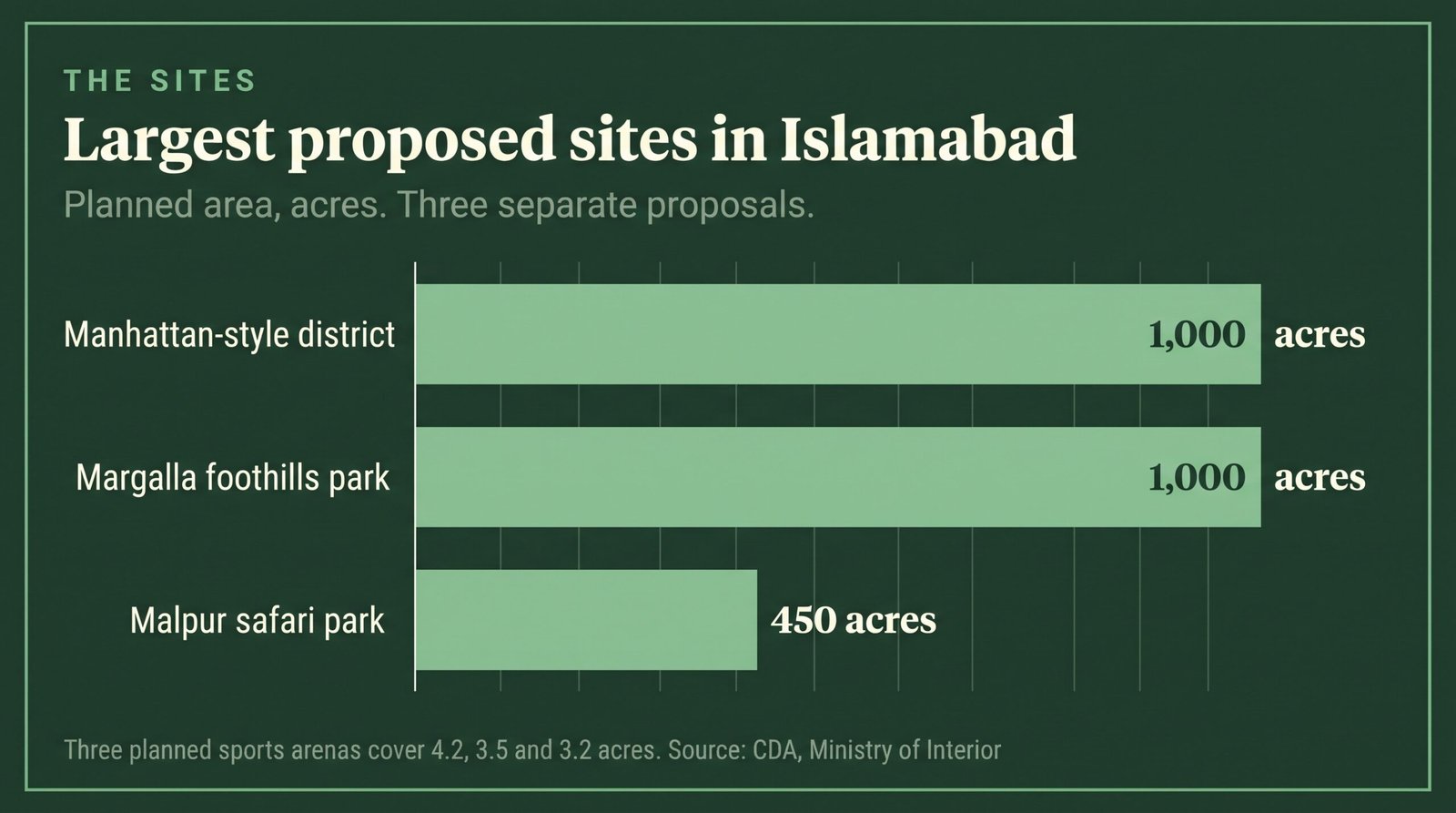
The development programme encompasses a proposed 450-acre safari park at Malpur, a 1,000-acre Manhattan-style commercial and residential district, a Saudi-backed international theme park, the conversion of One Constitution Avenue into a five-star hotel, a Rs19.371 billion convention and exhibition centre, a new cricket stadium, modern sports arenas and an expanding network of roads, underpasses and recreational facilities.
Beyond the headline projects, the government is pursuing an investment model designed to attract private developers, the recovery of valuable state land, expansion of international hospitality infrastructure, administrative digitisation and improvements in municipal services.
The initiatives are being advanced under the development priorities of Prime Minister Shehbaz Sharif, with Naqvi providing policy direction through the Ministry of Interior and Capital Development Authority (CDA) Chairman Sohail Ashraf overseeing the authority’s implementation responsibilities.
The government’s preparations for the Shanghai Cooperation Organisation (SCO) summit scheduled for August 2027 have provided an additional deadline for improving Islamabad’s transport, hospitality and international conference infrastructure.
However, the economic significance of the programme extends beyond preparations for a diplomatic gathering.
If implemented successfully, the projects could generate substantial construction activity, attract domestic and international investors, expand tourism and hospitality services and create thousands of direct and indirect employment opportunities.
The scale of investment actually realised and the number of jobs ultimately created will depend on financing, construction progress, commercial demand and the successful operation of the proposed facilities.
Islamabad’s Economic Transformation: Beyond Government Offices And Diplomatic Enclaves
For decades, Islamabad’s economy has been shaped primarily by federal ministries, diplomatic missions, educational institutions, public-sector organisations and a relatively concentrated commercial property market.
Although the capital has witnessed considerable residential and commercial expansion, its international tourism, entertainment, convention and sporting infrastructure remains comparatively limited.
The development programme being pursued under Naqvi seeks to broaden the city’s economic foundations by introducing projects that could generate sustained private-sector activity.
International hotels could attract business travellers and diplomatic delegations. Convention facilities could accommodate trade exhibitions and corporate gatherings. Safari parks and theme parks could stimulate domestic tourism, while high-rise developments could provide new space for offices, retail establishments and commercial enterprises.
Improved transport infrastructure and streamlined regulatory procedures could also reduce the costs of doing business.
The proposed strategy increasingly involves public-private partnerships and arrangements under which government land is used to attract private development capital.
This could allow the public sector to participate in major commercial developments without financing every project through conventional budgetary expenditure.
However, the financial benefits would depend on transparent land valuations, enforceable contracts and the commercial performance of completed developments.
Asia’s Largest Safari Park: A 450-Acre Tourism Destination At Malpur
Among the most prominent initiatives is Naqvi’s announcement of what he describes as Asia’s largest safari park, planned over approximately 450 acres in Islamabad.
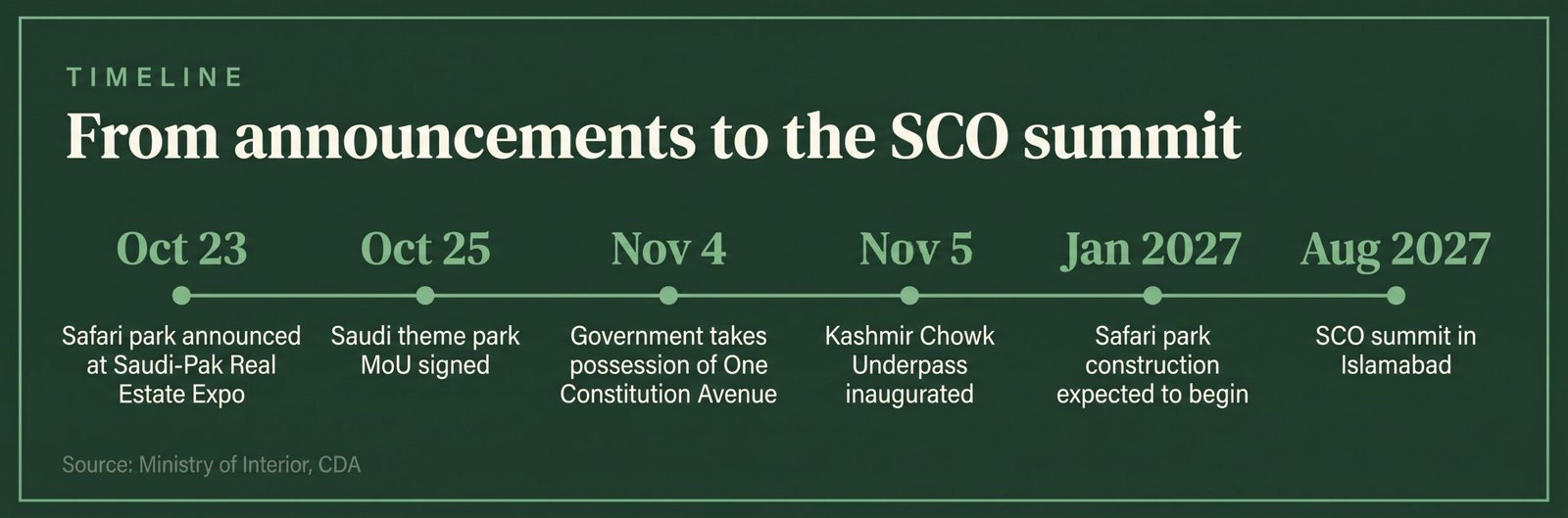
The interior minister first outlined the project during the Saudi-Pak Real Estate Expo in Lahore on October 23.
On November 5, he confirmed that the proposed facility would be developed at Malpur and announced that construction was expected to begin in January 2027.
According to Naqvi, an international consultant has already been engaged to assist with the project.
The proposed safari park could become an important addition to Islamabad’s recreational infrastructure and potentially establish the capital as a destination for wildlife tourism, family entertainment and conservation education.
A professionally managed safari park requires a diverse workforce, including veterinarians, wildlife specialists, animal-care personnel, landscape architects, environmental experts, engineers, maintenance teams, security staff and visitor-management professionals.
Construction would generate demand for contractors, skilled labour, machinery operators and suppliers.
Once operational, the facility could create recurring employment through tourism services, food outlets, retail establishments, transport, administration and recreational activities.
Its economic impact could extend to hotels, restaurants and businesses serving visitors from Rawalpindi, Punjab, Khyber Pakhtunkhwa and other regions.
Naqvi has previously cited the commercial potential of recreational facilities by referring to the redevelopment of a safari park in Punjab.
According to the minister, improvements to that facility increased its annual auction value from approximately Rs20 million to Rs680 million.
The example demonstrates the potential for professionally managed recreational assets to generate commercial revenue, although Islamabad’s project would require its own feasibility study and operating model.
The description of the proposed facility as Asia’s largest remains a government claim rather than an independently established continental ranking.
The final investment cost, annual visitor projections, revenue model and employment targets have yet to be publicly established.
Environmental safeguards, animal welfare standards and sustainable management will also be essential to the project’s success.
Saudi Investment Enters Islamabad’s Entertainment Industry
Another major initiative involves a proposed theme park to be developed with Saudi investment.
On October 25, a memorandum of understanding was signed at Lahore’s Gaddafi Stadium between Prince Mansour bin Mohammed Al Saud, Chairman of the Saudi-Pakistan Business Council, and CDA Chairman Sohail Ashraf.
Naqvi attended the signing ceremony and welcomed the investment proposal.
Under the announced arrangement, Saudi investors would provide investment while CDA would make land available for the development.
The project represents an attempt to expand Saudi-Pakistani investment cooperation into tourism, entertainment and commercial recreation.
A modern theme park could attract international entertainment operators, specialised equipment manufacturers and technology providers.
Its construction would create opportunities for engineers, contractors, electricians, mechanical specialists and skilled workers.
Following completion, the facility could support permanent employment in operations, maintenance, safety management, administration, hospitality, marketing and customer services.
The indirect economic benefits could extend to hotels, restaurants, transport companies, retailers and tourism businesses.
Naqvi has also announced plans for a real estate investment roadshow in Saudi Arabia to attract further investment into Islamabad’s commercial and hospitality sectors.
The proposed theme park could therefore become part of a broader effort to diversify investment relations between Pakistan and Saudi Arabia.
However, the memorandum of understanding remains a preliminary agreement.
Its final investment value, financing structure, land arrangements, construction schedule and operating model have not yet been publicly confirmed.
The project’s actual contribution to foreign direct investment will depend on binding financial commitments and implementation.
A 1,000-Acre Manhattan-Style District Behind The Prime Minister’s House
One of the most ambitious proposals involves the creation of a Manhattan-inspired commercial and residential district on approximately 1,000 acres behind the Prime Minister’s House.
Announcing the concept at the Saudi-Pak Real Estate Expo, Naqvi outlined plans for a modern urban development featuring residential towers, commercial complexes, a central park and a lake.
The district would operate under a proposed separate regulatory framework designed to facilitate investment and accelerate development approvals.
If realised, the project could create a new commercial destination within Islamabad, accommodating corporate headquarters, residential apartments, hotels, shopping centres, restaurants and other businesses.
Its construction could generate substantial demand for architects, structural engineers, urban planners, contractors, building-material suppliers and skilled labour.
Once completed, the commercial and residential developments could provide recurring employment through offices, retail outlets, property management, security, maintenance and hospitality services.
The proposed district could also attract overseas Pakistani investors and international real estate developers.
However, development on such a scale would require major investment in water supply, electricity, drainage, sewerage, roads, parking and public transport.
Its compatibility with Islamabad’s master plan and environmental requirements would also need careful assessment.
The project remains at the proposal stage, and its final investment requirement, financing arrangements and construction timetable have not been publicly established.
A New Investment Model: Government Land In Exchange For Completed Properties
Alongside the Manhattan-style development, Naqvi has proposed an investment arrangement intended to reduce the upfront financial burden on private developers.
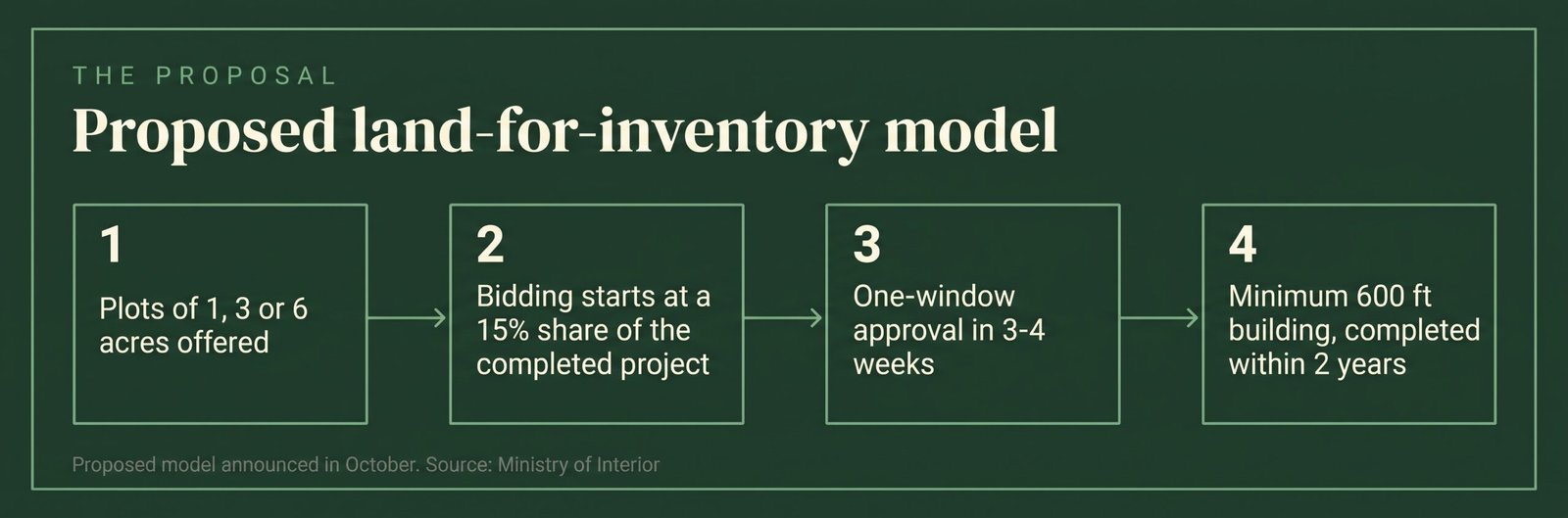
Under the model announced in October, investors would be offered plots measuring one, three or six acres for high-rise hotels, shopping malls and residential or commercial buildings.
Instead of paying the entire land price upfront, developers would provide the government with a share of the completed project’s inventory.
Bidding would begin at 15 per cent, with investors able to offer a higher share.
Naqvi also outlined a minimum building height of 600 feet and a two-year construction deadline following approval.
A one-window approval mechanism would aim to process applications within three to four weeks.
The minister proposed an auction committee involving representatives of CDA, NAB, FIA and the Special Investment Facilitation Council, with a judge heading the body.
The proposed model could reduce initial land-acquisition costs for developers while enabling the government to retain commercial assets in completed buildings.
It could also stimulate investment in construction, hospitality, retail and commercial property.
However, the arrangement would require transparent auctions, independent land valuations, enforceable completion guarantees and safeguards against project delays or developer defaults.
The value of the government’s inventory share would need to be assessed against the market value of the public land contributed.
Blue Area’s Changing Skyline: High-Rise Towers And Commercial Expansion
Islamabad’s commercial skyline is also expected to expand through new high-rise developments.
In October, CDA’s Design Vetting Committee granted in-principle approval to five major building projects, including two towers in Blue Area reaching approximately 659 feet.
The approvals form part of efforts to encourage vertical development and modern commercial infrastructure.
Blue Area already serves as one of Islamabad’s principal business districts.
Additional high-rise developments could increase the availability of modern office space, commercial property, retail facilities and hospitality infrastructure.
Construction would create opportunities for contractors, engineers, suppliers and skilled workers.
Following completion, the buildings could support permanent employment through commercial offices, retail establishments, restaurants, property management and maintenance services.
However, design approval does not establish that construction has begun or that project financing has been secured.
The final economic contribution will depend on completion, occupancy, market demand and supporting infrastructure.
One Constitution Avenue: Turning A Disputed Asset Into A Five-Star Hotel
One of the most significant recent decisions concerns One Constitution Avenue, a high-profile real estate development that has remained entangled in legal and financial disputes for years.
On November 4, Naqvi announced that the federal government had taken possession of the property following cabinet approval of recommendations submitted by a joint investigation team.
The government intends to convert the existing high-rise development into a five-star hotel through an arrangement with an internationally recognised hospitality operator.
The decision seeks to restore the property’s original designated purpose.
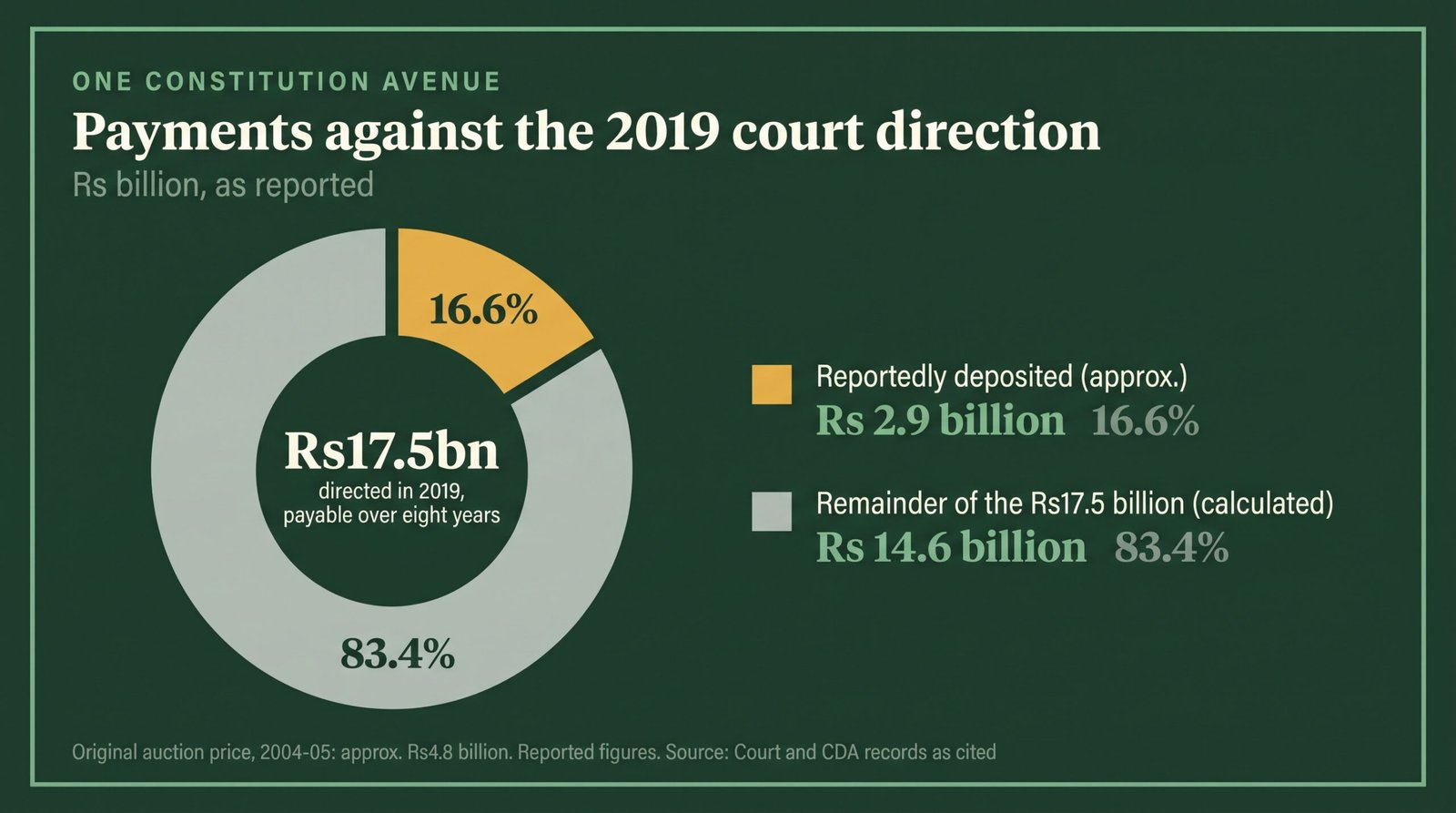
The plot was initially auctioned in 2004–05 for approximately Rs4.8 billion for a five-star hotel and serviced apartments.
The project subsequently became involved in disputes concerning payment obligations, development approvals and the sale of residential apartments.
In 2019, the Supreme Court directed the developer to pay Rs17.5 billion in instalments over eight years.
However, only approximately Rs2.9 billion had reportedly been deposited.
The Islamabad High Court subsequently upheld CDA’s cancellation of the allotment over payment defaults.
The government has announced compensation arrangements for affected apartment purchasers, with adjustments linked to KIBOR.
The proposed conversion could bring a valuable property into Islamabad’s international hospitality market.
A five-star hotel near major government and diplomatic institutions could accommodate visiting delegations, corporate executives, conference participants and business travellers.
Its operations could create employment in hotel management, food services, housekeeping, maintenance, security, administration and technical support.
The facility could also generate business for local suppliers, transport providers and hospitality-related enterprises.
However, outstanding legal claims, compensation arrangements, conversion costs and the selection of an international operator will require careful management.
Five-Star Hotel Joint Ventures And A Proposed Zero-Tax Investment Policy
The Constitution Avenue development forms part of a wider strategy to expand Islamabad’s luxury hospitality capacity.
During an April CDA meeting, Naqvi directed officials to pursue five-star hotel developments through joint ventures with internationally recognised companies.
Progress on a separate hotel initiative involving the Employees’ Old-Age Benefits Institution was also reviewed.
The minister additionally instructed officials to formulate a proposed zero-tax hotel policy intended to encourage investment.
New international hotels could strengthen Islamabad’s capacity to accommodate diplomatic delegations, corporate travellers, tourists and participants in major conferences.
They could also create employment across hospitality management, catering, housekeeping, maintenance, security and administration.
However, the proposed tax incentives would need to be assessed against their fiscal cost and the additional investment they generate.
The precise scope, duration and legal basis of the proposed zero-tax arrangement have yet to be clarified.
Rs19.371 Billion Convention Centre: Building Islamabad’s International Conference Economy
A major component of the development programme is the proposed New Islamabad Convention, Expo and Exhibition Centre.
In November 2025, the CDA Development Working Party approved the project’s PC-I at an estimated cost of Rs19.371 billion.
The facility is intended to host international conventions, trade exhibitions, cultural events, corporate gatherings and major official functions.
The original implementation period was set at 18 months.
In January 2026, Naqvi inspected a proposed site near Murree Road and the Bhara Kahu Bypass, directing officials to resolve encroachment-related issues.
On November 5, he announced that construction would begin within 15 days.
The project has particular significance because Islamabad is preparing to host the SCO Council of Heads of State summit in August 2027.
A modern convention centre could expand the capital’s ability to host international business conferences, investment forums and trade exhibitions.
Such events generate demand for hotel accommodation, transport, restaurants, exhibition contractors, audiovisual companies, security providers and event-management businesses.
They can also create opportunities for Pakistani exporters and entrepreneurs to establish international commercial relationships.
However, the facility’s long-term economic performance will depend on regular bookings and effective management after the SCO summit.
Its annual operating costs, projected revenue and expected utilisation will therefore be important indicators of commercial sustainability.
Islamabad Cricket Stadium: Creating A Sports And Entertainment Economy
The government is also pursuing a new cricket stadium in Islamabad.
The project was discussed during CDA meetings earlier in 2026, with officials directed to finalise its design.
On November 5, Naqvi announced plans to seek the prime minister’s availability for a groundbreaking ceremony the following week.
As Chairman of the Pakistan Cricket Board, Naqvi is directly involved in the development of the country’s cricket infrastructure.
A modern stadium could provide Islamabad with opportunities to host domestic and international cricket fixtures, subject to scheduling and relevant approvals.
Major sporting events generate commercial activity through ticket sales, broadcasting, advertising, sponsorship, hospitality, merchandising and transport.
Construction would create temporary employment, while stadium operations could support permanent positions in groundskeeping, maintenance, security, administration and event management.
A stadium designed for year-round use could also accommodate additional sporting and entertainment activities.
However, the final construction cost, seating capacity, financing arrangements and operating model have not yet been publicly established.
Three Modern Sports Arenas: Investment In Recreation And Youth Development
CDA has also announced plans for three modern sports arenas in different parts of Islamabad.
The proposed facilities include sites in D-12/1, G-11/3 Markaz and F-8 Markaz.
The D-12/1 facility would cover approximately 4.2 acres, the G-11/3 arena around 3.5 acres and the F-8 facility approximately 3.2 acres.
The planned amenities include indoor swimming pools, gyms, futsal courts, cricket cages, padel courts, basketball facilities, multipurpose sports halls, children’s play areas and supporting infrastructure.
The initiative could expand access to organised sports and create opportunities for coaches, trainers, facility managers, maintenance workers and administrative personnel.
It could also support local tournaments, sports academies and small businesses providing sports equipment and services.
The final economic impact will depend on construction progress, accessibility, pricing and operating arrangements.
Golf, Water Parks, Hot-Air Balloons And Adventure Tourism
The recreational development agenda extends beyond the safari park and Saudi-backed theme park.
During an April 2026 meeting, Naqvi directed officials to pursue plans for a Top Golf-style facility, hot-air balloon rides, zip lines, a water park, an amusement park and modern sports complexes.
The government also discussed recreational facilities around Shahdara Dam and improvements to existing tourism destinations.
These initiatives could help diversify Islamabad’s leisure economy by introducing additional organised entertainment and adventure activities.
Such facilities can generate employment for instructors, technicians, safety specialists, equipment operators, maintenance workers and hospitality staff.
They could also encourage longer tourist stays and increased spending in local restaurants, hotels and retail outlets.
However, these projects remain proposals requiring feasibility studies, safety assessments, environmental approvals and financing commitments.
A 1,000-Acre Park At The Margalla Foothills
Environmental and recreational development also features prominently in the programme.
According to the government’s April 21 announcement, a new public park is proposed over approximately 1,000 acres at the foothills of the Margalla Hills.
The decision was taken during a meeting chaired by Naqvi at CDA headquarters.
The project is intended to provide additional recreational facilities while preserving Islamabad’s green character.
A large public park could support outdoor recreation, environmental education, organised sporting activities and tourism.
It could also generate employment through landscaping, maintenance, visitor services, security and recreational management.
However, the location’s ecological sensitivity makes environmental safeguards particularly important.
Any development near the Margalla Hills should be accompanied by appropriate environmental assessments, sustainable water management and protection of natural habitats.
The proposed park is separate from the 1,000-acre Manhattan-style commercial district and the 450-acre safari park.
F-9 Park, Lake View Park And Islamabad’s Green Infrastructure
The government is also pursuing improvements to existing public spaces.
Naqvi has announced plans to upgrade F-9 Park along the lines of London’s Hyde Park, with improved lighting, walkways, landscaping and recreational amenities.
The minister has emphasised protecting existing trees and avoiding unnecessary concrete construction.
Additional improvements have been discussed for Lake View Park, Daman-e-Koh, Shahdara Dam and other recreational destinations.
These initiatives could improve Islamabad’s attractiveness for residents and visitors while supporting tourism-related businesses.
Well-maintained parks and public spaces can also contribute to urban liveability and environmental sustainability.
However, commercial activity within public parks should be managed carefully to preserve public access and ecological value.
Kashmir Chowk Underpass: Rs1.4 Billion Project Completed In 27 Days
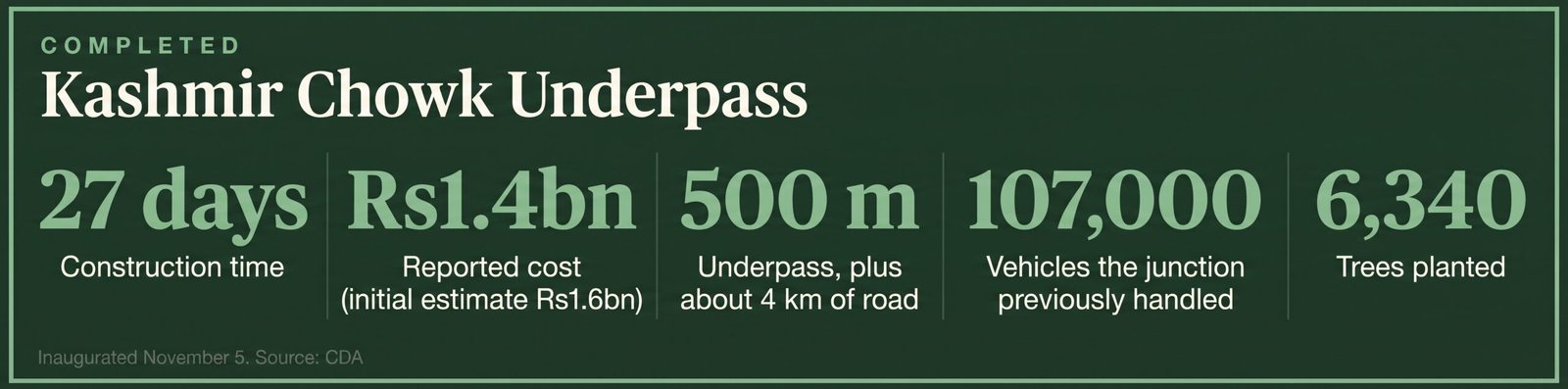
The inauguration of Kashmir Chowk Underpass on November 5 marked a major milestone in the capital’s infrastructure programme.
Prime Minister Shehbaz Sharif inaugurated the project after construction was completed in 27 days.
The development includes a 500-metre underpass and approximately four kilometres of associated road infrastructure.
The reported project cost was around Rs1.4 billion, compared with an initial estimate of Rs1.6 billion.
According to CDA, the junction previously handled approximately 107,000 vehicles, creating congestion and traffic delays.
Naqvi said the project had been completed under third-party quality supervision and that 6,340 trees had been planted.
The underpass is intended to improve traffic movement between Islamabad and Rawalpindi and facilitate access to important parts of the capital.
Reduced congestion can lower transport costs, save commuting time, improve commercial deliveries and support economic productivity.
The project’s longer-term impact should be assessed through traffic counts, journey-time savings, road safety and maintenance performance.
Islamabad Expressway, Faisal Mosque Underpass And Pedestrian Bridges
The government is pursuing additional improvements to Islamabad’s transport network.
Naqvi has directed CDA officials to advance the Islamabad Expressway Service Road project and plans for an underpass near Faisal Mosque.
Other reported infrastructure works include road improvements in the Diplomatic Enclave, rehabilitation of commercial and residential streets and projects involving Margalla Road, Ninth Avenue, Shaheen Chowk and Faisal Avenue.
CDA has also approved six steel pedestrian bridges at an estimated cost of Rs574.682 million, with an implementation period of 18 months.
The bridges are intended to improve pedestrian safety and accessibility.
Transport infrastructure is particularly important because Islamabad and Rawalpindi function as an interconnected urban economy.
Large numbers of workers, students, businesses and service providers travel between the two cities daily.
Better connectivity could reduce commuting costs and improve access to employment and commercial opportunities.
However, road expansion should be accompanied by improvements in public transport, pedestrian access and parking management.
Recovering State Land: The Financial Significance Of CDA’s Anti-Encroachment Drive
One of the less visible but financially significant aspects of the development programme involves the recovery of public land.
CDA has reported recovering state assets with an estimated value of approximately Rs1.3 trillion through anti-encroachment and land-recovery operations.
The authority has also reported recovering substantial areas of government land near the Prime Minister’s House and in other parts of the capital.
On November 4, Naqvi announced that approximately 1,000 acres adjacent to the Prime Minister’s House and land associated with the proposed safari park had been recovered.
He also said efforts were continuing to retrieve government land in sectors E-12, C-14, C-15 and C-16.
The reported Rs1.3 trillion figure represents CDA’s estimated value of recovered assets rather than cash revenue received by the government.
The economic importance of land recovery lies in restoring public control over property that may be used for infrastructure, planned urban development, commercial investment and other public purposes.
Recovered land could strengthen CDA’s financial position if utilised through transparent and commercially viable arrangements.
However, recovery operations must comply with due process and respect legitimate property rights.
The final public benefit will depend on how the recovered assets are managed.
Digitising CDA: Modernising Land Records And Investment Approvals
Administrative reform is another major component of the development programme.
In April, Naqvi directed CDA to digitise its records within 120 days.
The initiative was intended to improve transparency, reduce administrative delays and enable citizens to monitor applications through digital systems.
The proposed reforms include digitisation of property-transfer records, a one-window service dashboard and improvements to land-management procedures.
Naqvi also directed officials to prevent illegal housing societies from operating in Islamabad and strengthen action against unauthorised developments.
These measures could improve the investment environment by reducing uncertainty surrounding property ownership, development approvals and administrative procedures.
Digitised land records could also reduce disputes, improve transaction efficiency and strengthen public confidence in the regulatory system.
However, the original 120-day deadline has passed, and the extent of completed digitisation requires confirmation through an updated operational assessment.
Khidmat Markaz, Safe City And Emergency Services
The development programme also includes improvements to citizen services and emergency response.
Land has been allocated for a proposed Khidmat Markaz in Sector F-6 to improve public access to administrative services.
CDA meetings have also discussed establishing an emergency-services control room within the Safe City framework.
The broader programme includes proposals to strengthen emergency response infrastructure and improve the availability of organised public services.
These facilities could support employment for administrative staff, emergency responders, technical personnel, IT specialists and service providers.
More efficient public services could also reduce the time and expense citizens and businesses incur when dealing with government departments.
Their final impact will depend on staffing, operational readiness, technology integration and accessibility.
The 2027 SCO Summit: A Deadline For Islamabad’s Transformation
Pakistan’s planned hosting of the SCO Council of Heads of State summit in August 2027 has become an important reference point for Islamabad’s development programme.
The event is expected to bring international delegations to the capital, increasing demand for secure transport, conference facilities, hotel accommodation and urban services.
Naqvi has stated that the government intends to give Islamabad a substantially different appearance before the summit.
The convention centre, hospitality initiatives, road improvements and recreational projects form part of the wider development agenda.
The summit could provide a platform for presenting Pakistan’s investment opportunities and infrastructure improvements to international visitors.
However, the lasting economic value of these projects will depend on their usefulness after the event.
Hotels, convention facilities and transport infrastructure should be designed to serve residents, businesses and visitors throughout the year rather than exclusively during major diplomatic gatherings.
Thousands Of Jobs: Understanding The Economic Opportunity
The development programme could generate employment through several interconnected sectors.
Construction would create demand for engineers, architects, contractors, electricians, plumbers, machine operators, surveyors, skilled tradespeople and building-material suppliers.
Hospitality developments could provide permanent employment for hotel managers, chefs, housekeeping staff, receptionists, maintenance workers, security personnel and administrative teams.
Tourism and recreational projects could support wildlife professionals, park operators, guides, technicians, trainers, retailers, transport providers and food-service workers.
Commercial towers and new business districts could create opportunities in finance, retail, technology, property management, marketing and professional services.
Convention and sporting facilities could support event organisers, broadcasters, technicians, security staff, logistics providers and hospitality businesses.
The economic benefits could extend beyond direct employment through supply chains and increased visitor spending.
However, no consolidated, independently verified employment estimate has been published for the entire programme.
The prospect of thousands of jobs is therefore an economic possibility rather than an established employment commitment.
The number of positions ultimately created will depend on investment commitments, construction activity, project completion and the commercial performance of operational facilities.
Can Islamabad Attract Billions In Private Investment?
The proposed development programme could attract substantial domestic and foreign capital if the projects reach financial close and proceed to construction.
Islamabad’s status as the federal capital, its concentration of diplomatic and corporate institutions, demand for commercial property and the government’s proposed investment arrangements provide a basis for attracting developers.
The Saudi-backed theme park represents one effort to bring foreign investors into a new commercial sector.
The proposed land-for-inventory model could also encourage developers by reducing upfront land-acquisition costs.
Luxury hotels, high-rise commercial buildings and entertainment facilities may appeal to investors seeking long-term revenue streams.
However, announced project values should not be confused with committed or realised investment.
For projects to contribute meaningfully to foreign direct investment, agreements must progress to financing, capital deployment, construction and operation.
A consolidated project-wise investment statement from CDA would help establish the scale of committed capital and distinguish public expenditure from private investment.
Financing, Transparency And Environmental Sustainability: The Challenges Ahead
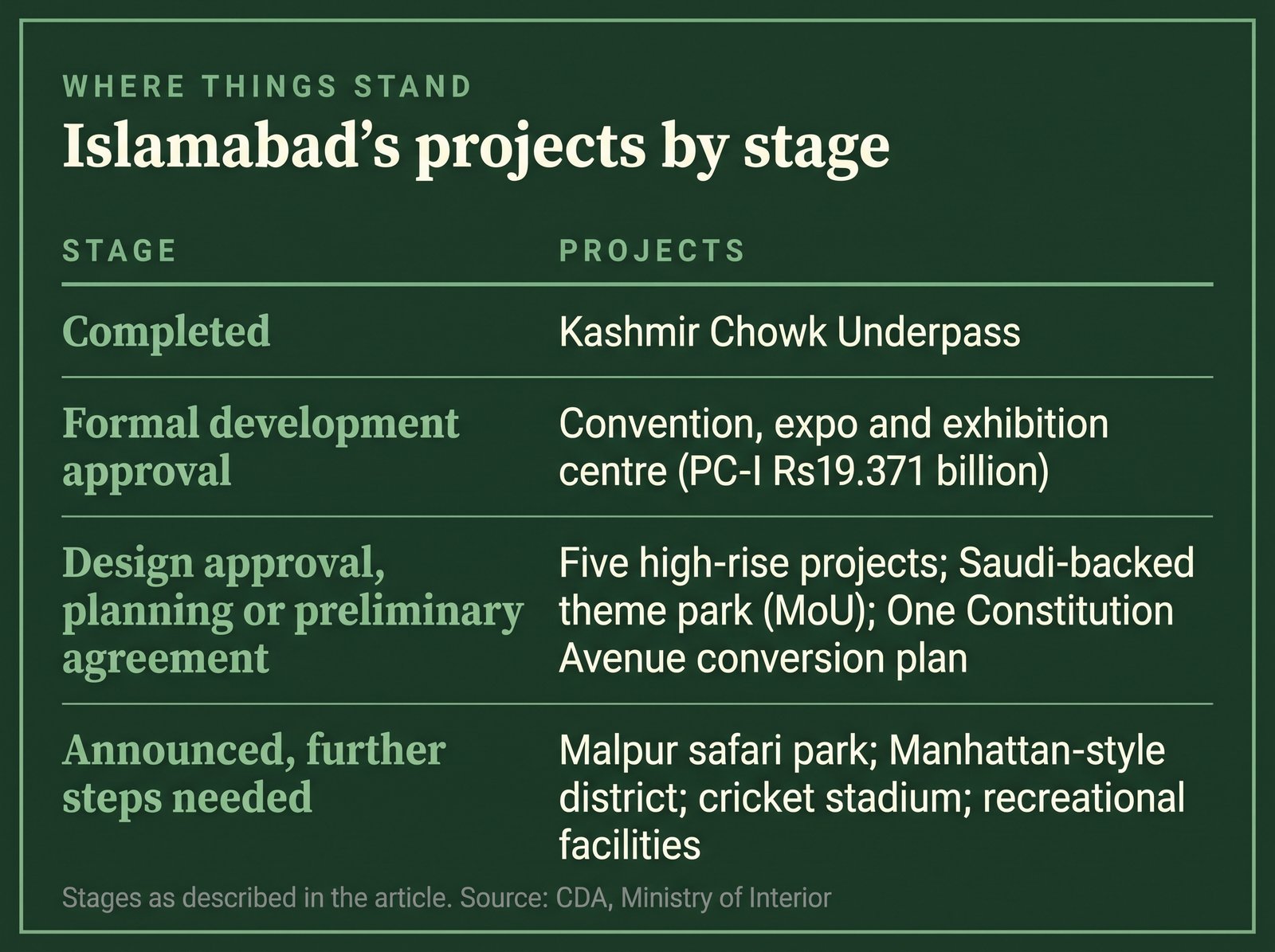
The development programme includes projects at different stages of implementation.
Kashmir Chowk Underpass has been completed and inaugurated.
The convention centre has received formal development approval, while several other initiatives have reached design approval, planning or preliminary investment-agreement stages.
The proposed safari park, Manhattan-style district, cricket stadium and recreational facilities still require further implementation steps.
This distinction is essential when assessing the government’s development record.
Large projects can encounter delays because of land disputes, environmental approvals, financing constraints, procurement issues and infrastructure requirements.
Public-private partnerships also require contractual safeguards to protect public assets and prevent excessive financial exposure.
Environmental sustainability is another major consideration.
Islamabad’s green spaces, natural landscape and proximity to the Margalla Hills are central to its identity.
Commercial expansion should therefore be accompanied by responsible land-use planning, adequate water supply, wastewater management, transport infrastructure and environmental protection.
The government will also need to ensure that new commercial districts do not divert attention from existing residential sectors requiring improvements in sanitation, street maintenance, drainage and public services.
Beyond Construction: The Economic Future Of Pakistan’s Capital
The scale and diversity of the initiatives being pursued under Mohsin Naqvi reflect an effort to expand Islamabad’s economic role beyond public administration.
The proposed safari park, Saudi-backed theme park, luxury hotels, convention centre, commercial district, sports facilities and road improvements could collectively strengthen the city’s tourism, hospitality, real estate and service sectors.
The initiatives could also create opportunities for foreign investors, Pakistani businesses, construction companies and entrepreneurs seeking to participate in new commercial activity.
Also Read: Pioneer Cement Supercharges Green Transition with 15MW Battery Storage and New 10MW Solar Deal
CDA’s land-recovery and digitisation efforts could strengthen the institutional framework supporting development.
Yet the success of the programme cannot be measured solely by the number of announcements, buildings or groundbreaking ceremonies.
The more meaningful indicators will be the amount of private investment actually realised, the number of jobs created, the economic activity generated by completed facilities, the revenue earned by public institutions and the improvements experienced by residents.
The inauguration of Kashmir Chowk Underpass provides an example of a completed infrastructure project, while the larger commercial and tourism initiatives remain tests of financing, implementation and long-term management.
For Islamabad, the opportunity is to build a more diversified urban economy capable of supporting tourism, international business, modern hospitality, sports and commercial investment.
For the government, the challenge is to ensure that development translates into measurable public benefit.
If the proposed projects progress from announcements and preliminary agreements into functioning commercial and public facilities, Islamabad could experience a significant expansion of employment, investment and tourism activity. Their lasting contribution will ultimately be determined not by the scale of the plans, but by the economic opportunities and public services they deliver.